Category: Cancer

  • Understanding Multidisciplinary Teams (MDT) in Abdominal Sarcoma Care

    Understanding Multidisciplinary Teams (MDT) in Abdominal Sarcoma Care

    What isa Multidisciplinary Team (MDT) mean?

    Multidisciplinary Team (MDT) is a group of healthcare professionals from different specialties who work together to plan and deliver the best possible care for a patient.

    When treating complex conditions like abdominal sarcomas, no single doctor can handle every aspect of care. That’s where the MDT comes in.

    Who is in the MDT?

    Depending on the case, the team may include:

    • Surgeons – to plan and perform any necessary operations
    • Medical Oncologists – to advise on chemotherapy or targeted treatments
    • Radiation Oncologists – if radiation therapy is needed
    • Radiologists – to interpret imaging studies like CT or MRI scans
    • Pathologists – to study biopsy results and confirm the diagnosis
    • Nurses and Care Coordinators – to support and guide you through treatment
    • Physiotherapists, Dietitians, and Psychologists – as needed, to help with recovery and well-being

    Why It Matters:

    An MDT ensures that all aspects of your care are considered from different medical viewpoints. It leads to better decisions, more personalised treatment, and a higher chance of success.

    How do patients fare in the long run?

    Prognosis refers to the likely outcome of the disease—how it may progress and how well a person is expected to fare after treatment.

    The prognosis for abdominal sarcoma can vary widely depending on several factors:

    Factors That Affect Prognosis:

    • Type of Sarcoma: Some types, like GIST with specific mutations, respond well to targeted treatment, while others may be more aggressive.
    • Tumour Size and Location: Smaller tumours that can be removed entirely tend to have a better outcome.
    • Surgical Margins: If the tumour is removed with clear margins (no cancer cells left at the edges), the chance of cure or long-term control is higher.
    • Spread of Disease: If the sarcoma has spread (metastasised), treatment becomes more complex, and long-term control is more challenging.
    • Patient’s Age and General Health: Younger and healthier patients usually tolerate treatment better and may have better outcomes.

    The Good News:

    • Many abdominal sarcomas, if detected early and appropriately treated by a specialised team, can be effectively managed or cured.
    • Even in advanced cases, treatment can help control the disease, relieve symptoms, and improve quality of life.

    Follow-Up Is Key

    Regular follow-up scans and check-ups are essential, as some sarcomas can come back (recur) after treatment. Early detection of recurrence offers better chances of successful treatment again.

    FAQs

    Are abdominal sarcomas cancerous?

    Yes. Abdominal sarcomas are a type of cancer that originates in the soft tissues of the abdomen, including fat, muscle, and connective tissue. They are rare but can be serious, especially if not treated early. Some related tumours, like desmoid tumours, are not considered cancer, but they can behave aggressively and may still require treatment.

    Can abdominal sarcoma be cured?

    Yes, in many cases. If detected early and obliterated with surgery, some abdominal sarcomas can be cured. Even if a cure is not possible, treatments like chemotherapy, radiation, or targeted therapy can help control the disease and improve quality of life. Long-term follow-up is crucial for monitoring recurrence.

    What symptoms should I watch for?

    Abdominal sarcomas may not cause symptoms in the early stages. As they grow, you may notice:

    • A lump or swelling in the abdomen
    • Abdominal discomfort or pain
    • Feeling full quickly
    • Unexplained weight loss

    If you have any of these symptoms for more than a few weeks, it’s important to see a doctor for evaluation.

    Can abdominal sarcomas come back after treatment?

    Yes, abdominal sarcomas can sometimes come back (recur) even after successful treatment. The risk of recurrence depends on factors like the type of sarcoma, size, how completely it was removed, and whether it had spread.

    This is why regular follow-up with scans and check-ups is very important. Early detection of recurrence gives doctors a better chance to treat it effectively again.
  • Abdominal Sarcomas: What You Need to Know About Diagnosis and Treatment?

    Abdominal Sarcomas: What You Need to Know About Diagnosis and Treatment?

    How Are Sarcomas Diagnosed?

    Advitya healthcares abdominal sarcomas: what you need to know about diagnosis and treatment?

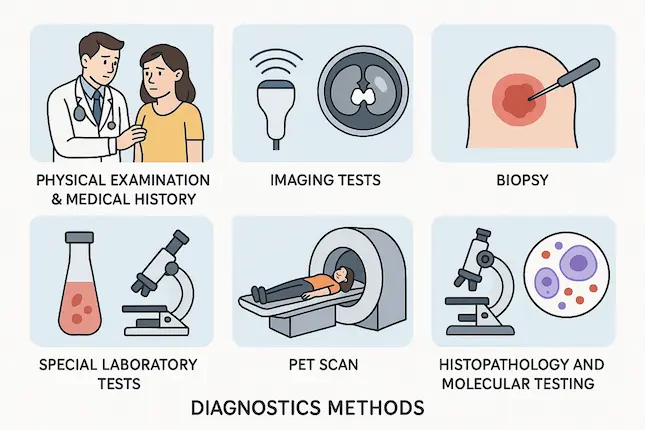
    Diagnosing an abdominal sarcoma involves several steps, as these tumours are rare and often located deep inside the body. Here’s how doctors typically find out what’s going on:

    1. Physical Examination & Medical History
      Your doctor may start by asking about symptoms such as pain, swelling, or a lump in the abdomen and then perform a physical examination.
    2. Imaging Tests
      • Ultrasound: Often the first test used if a lump or swelling is suspected.
      • CT Scan or MRI: These provide detailed images of the inside of the abdomen, helping doctors understand the size, location, and extent of the tumour.
    1. Biopsy
      A biopsy may help to confirm the diagnosis. A small sample of the tumour is taken, usually with a needle under imaging guidance, and examined under a microscope to determine the type of sarcoma.
    2. Special Laboratory Tests
      The biopsy sample may also undergo additional tests, such as immunohistochemistry or genetic analysis, to help pinpoint the exact type of sarcoma or soft tissue tumour.
    3. PET Scan (in selected cases)
       This test may be done to check if the tumour has spread to other parts of the body.
    4. Histopathology and Molecular Testing
      Histopathology involves examining the tumor tissue under a microscope to identify the specific type of sarcoma and its characteristics, while molecular testing analyzes the genetic makeup and protein markers of the tumor cells. These detailed analyses are crucial for determining the most effective treatment approach, as different sarcoma subtypes respond differently to various therapies like targeted drugs or chemotherapy.

    What will be included in the treatment of an abdominal sarcoma?

    What will be included in the treatment of an abdominal sarcoma

    Management of abdominal sarcomas is multimodal and individualised. The primary goal is to achieve complete tumour control while preserving organ function.

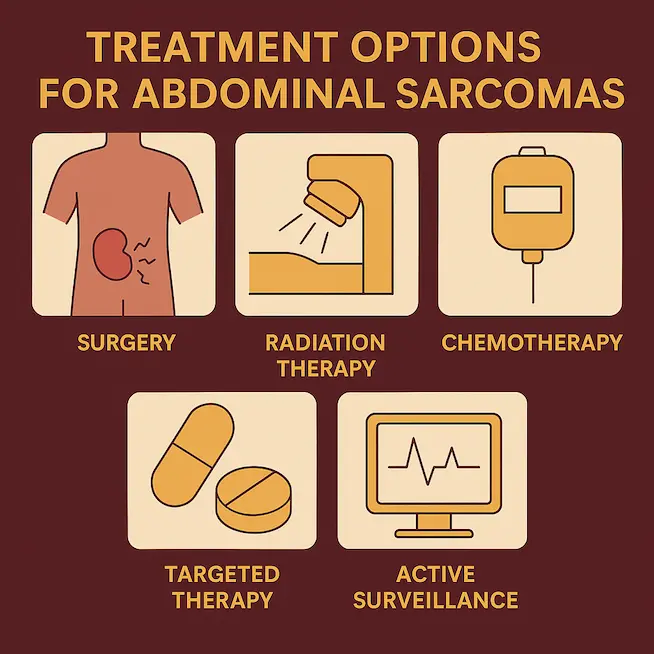
    Treatment for abdominal sarcomas depends on the type, size, location, and stage of the tumor, as well as the patient’s overall health. A team of specialists usually works together to plan the best approach. Here are the main treatment options:

    1. Surgery
       Surgery is often the first and most important treatment. The goal is to remove the tumor completely, along with a margin of healthy tissue around it to reduce the risk of recurrence. Sometimes nearby organs may need to be partially removed if they are involved.
    2. Radiation Therapy
       Radiation may be used before surgery to shrink the tumor, or after surgery to kill any remaining cancer cells. In some cases where surgery is not possible, radiation may be the main treatment.
    3. Chemotherapy
       Chemotherapy is not always effective for all sarcomas, but it may be used in certain types or advanced cases, especially when the cancer has spread. It may also be used before surgery in select patients.
    4. Targeted Therapy
       Some sarcomas like GIST respond well to targeted drugs (such as imatinib) that block specific cancer-driving proteins. This is often used when surgery alone isn’t enough.
    5. Active Surveillance
       In low-risk cases like small desmoid tumors or in situations where surgery may cause more harm than benefit, doctors may recommend close observation with regular scans.

    A Personalized Approach

    Every sarcoma is different. Your treatment plan will be personalized based on the exact diagnosis. A multidisciplinary team—including surgeons, oncologists, and radiologists—will work together to give you the best outcome.

  • Understanding Abdominal Sarcomas: What a patient should know?

    Understanding Abdominal Sarcomas: What a patient should know?

    What Are Abdominal Sarcomas?

    Advitya healthcares understanding abdominal sarcomas

    Abdominal sarcomas are rare cancers that originate from the connective tissues within the abdomen, such as fat, muscle, nerves, fibrous tissue, or blood vessels. Unlike the more common cancers that start in organs like the colon or pancreas, sarcomas develop in the soft tissues or mesenchymal tissue, which forms structural and supportive parts of the body.

    These tumours are classified into two major groups:

    • Retroperitoneal Sarcomas: These develop in the space behind the abdominal organs, known as the retroperitoneum.
    • Intra-abdominal Sarcomas: Arise within abdominal organs or the abdominal wall.

    Though sarcomas are rare (making up <1% of all adult cancers), they can behave aggressively and require specialised care.

    What are the causes of Abdominal Sarcomas?

    • Genetic Conditions
      Some people inherit conditions that make them more likely to develop sarcomas. These include genetic syndromes like Li-Fraumeni syndrome and Neurofibromatosis type 1.
    • Radiation Exposure
      People who have received radiation therapy in the past, especially to the abdominal area, may have a higher risk of developing soft tissue sarcomas years later.
    • Chemical Exposure
      Long-term exposure to certain chemicals such as vinyl chloride, dioxins, or herbicides may increase the risk in some individuals.
    • Chronic Swelling or Injury
      Although rare, long-standing swelling or injury in a certain part of the body may, over time, contribute to the development of sarcomas.
    • Unknown Causes
      In many cases, there is no clear cause. Sarcomas can occur without any family history, exposure, or warning signs.

      Abdominal sarcomas are not caused by lifestyle factors like diet or stress. They are uncommon and can affect anyone. 

    What are the common types of soft tissue sarcomas?

    • Liposarcoma
       This type originates in fat cells and is one of the most common types of abdominal sarcomas. It usually grows slowly but can become large before causing symptoms.
    • Leiomyosarcoma
       This type of cancer begins in smooth muscle tissue, often originating from the walls of the intestines or blood vessels in the abdomen. It may grow more aggressively than some other types.
    • Gastrointestinal Stromal Tumour (GIST)
       GISTs arise from special cells in the wall of the digestive tract. They are a unique type of sarcoma and are often treated differently, sometimes with targeted medicines.
    • Undifferentiated Pleomorphic Sarcoma (UPS)
       Previously called malignant fibrous histiocytoma, this is a high-grade tumour that doesn’t resemble any specific tissue type. It can occur in the retroperitoneum (deep part of the abdomen).
    • Desmoid Tumours (Aggressive Fibromatosis)
       Although not considered a true sarcoma or cancer, desmoid tumours arise from connective tissue and can grow aggressively. They do not spread to other organs, but they can invade nearby tissues and sometimes recur after treatment. Management often includes surgery, medications, or close monitoring depending on the case.
    • Other Rare Types
       These include synovial sarcoma, angiosarcoma, and fibrosarcoma, each with its own behaviour and treatment approach.

    What are the common symptoms?

    Chatgpt image jul 4, 2025, 01 11 24 pm

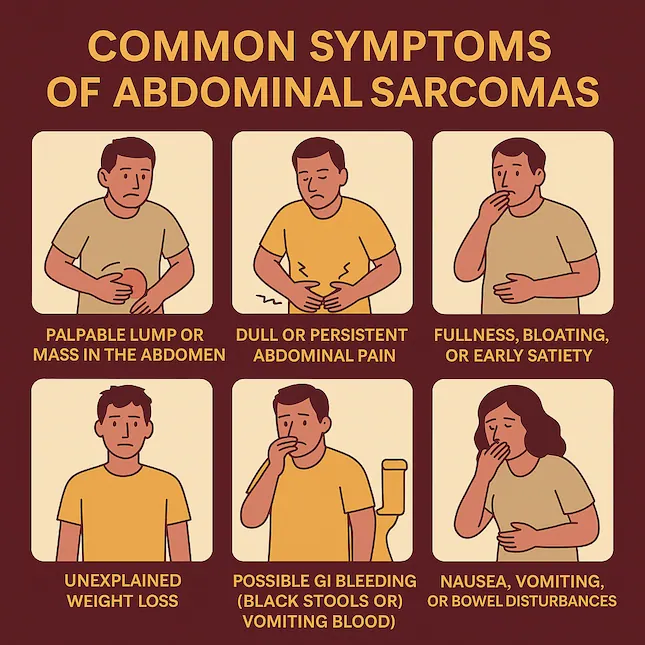
    Early abdominal sarcomas are often asymptomatic due to their deep location and slow growth. However, symptoms may appear as the tumor enlarges:

    • Palpable lump or mass in the abdomen
    • Dull or persistent abdominal pain
    • Fullness, bloating, or early satiety
    • Unexplained weight loss
    • Nausea, vomiting, or bowel disturbances
    • In GISTs: possible GI bleeding (black stools or vomiting blood)

    Any persistent, unexplained abdominal symptoms should prompt medical evaluation.

    In the event of these symptoms, the patient should consult a GI expert promptly.

    Continue Your Journey to Understanding Abdominal Sarcomas

    This comprehensive guide is part of our 3-part series on abdominal sarcomas. I, Advitya, believe that knowledge empowers patients and families to make informed decisions about their healthcare journey. So, stay tuned for part 2 – Abdominal Sarcomas: What You Need to Know About Diagnosis and Treatment?