Category: GI Health

  • Your guide to Pancreatic Cancer, Everything You Need to Know

    Your guide to Pancreatic Cancer, Everything You Need to Know

    PancreaCare by
    Advitya Healthcares

    Covering: Oesophageal  |  Stomach  |  Liver  |  Gallbladder  |  Bile Duct
    Pancreatic  |  Small Bowel  |  Colon  |  Rectal  |  Anal  |  GIST  |  NETs

    Warning Signs: When to See a Doctor

    Red Flag Symptoms — Never Ignore These    
    Unexplained weight loss or loss of appetite   Difficulty swallowing or pain when swallowing   Persistent indigestion, heartburn, or abdominal pain   Vomiting blood, or vomit that looks like coffee grounds   Black, tarry, or bloody stools   New jaundice — yellowing of skin or whites of the eyes   Dark urine and pale/clay-coloured stools   A change in bowel habits lasting more than 3 weeks   Unexplained new anaemia (low blood count)   New-onset diabetes after age 50, especially with weight loss   A lump or swelling in the abdomen   If you have any of these — please make an appointment with your GP today. Early detection genuinely saves lives.

    Pancreatic Cancer

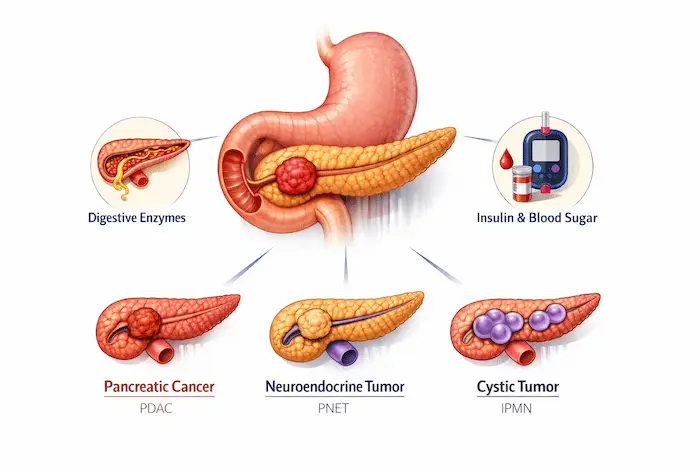
    What Is It?

    advitya healthcares

    Why Does It Happen? (Causes & Risk Factors)
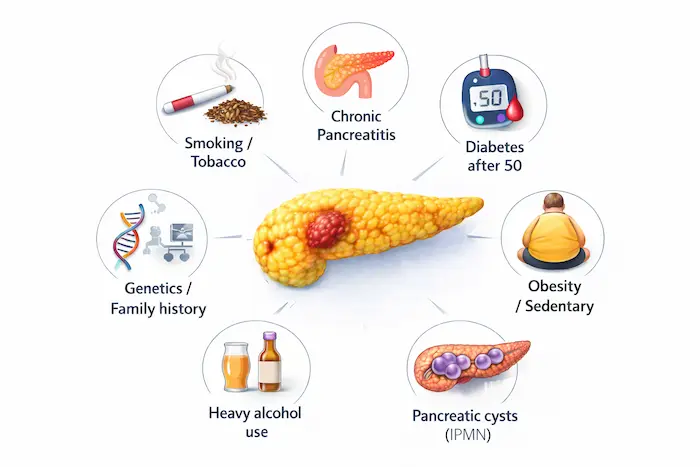
    advitya healthcares

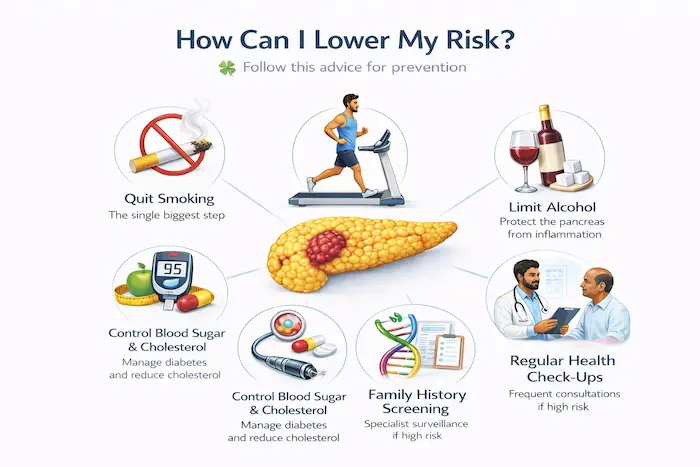
    How Can I Lower My Risk?

    advitya healthcares

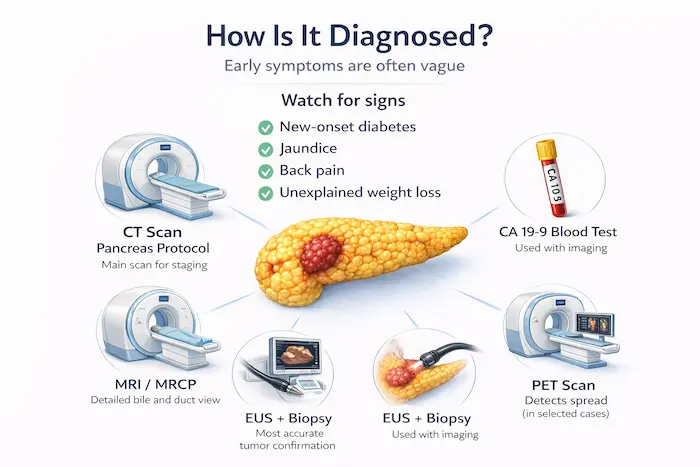
    How Is It Diagnosed?

    advitya healthcares

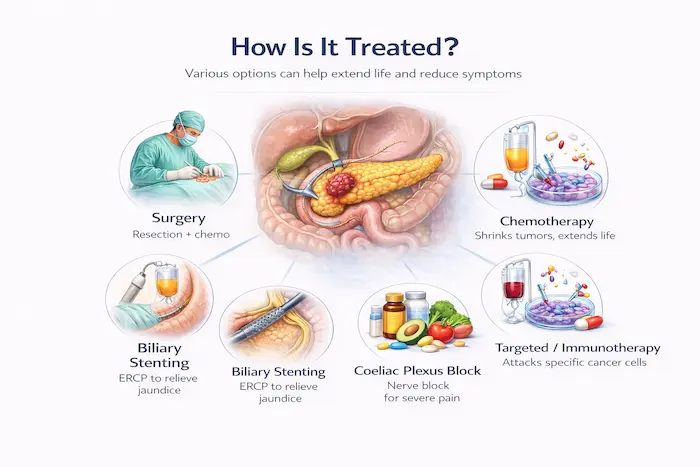
    How Is It Treated?

    advitya healthcares
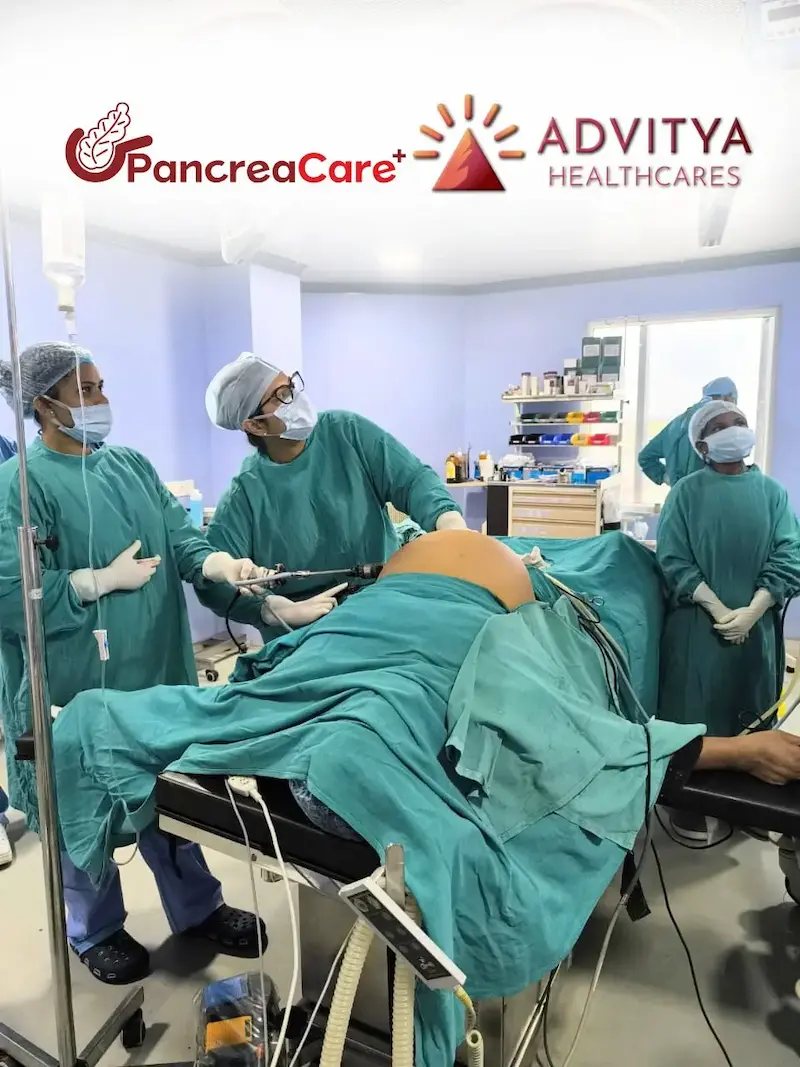
    The Surgery: Whipple Procedure (Pancreaticoduodenectomy) The Whipple is one of the most complex abdominal operations performed. It is used for cancers in the head of the pancreas. What is removed: the head of the pancreas, the first part of the small bowel (duodenum), the lower bile duct, the gallbladder, and sometimes part of the stomach. Three reconnections are then made: the remaining pancreas to the bowel (pancreaticojejunostomy), the bile duct to the bowel (hepaticojejunostomy), and the stomach to the bowel (gastrojejunostomy). Distal pancreatectomy: for cancers in the body or tail — removes the left side of the pancreas, often with the spleen. Total pancreatectomy: removes the entire pancreas — used in selected cases; results in insulin-dependent diabetes. Hospital stay: 7-14 days. Recovery: 6-8 weeks.

    Aftercare & Recovery

    advitya healthcares
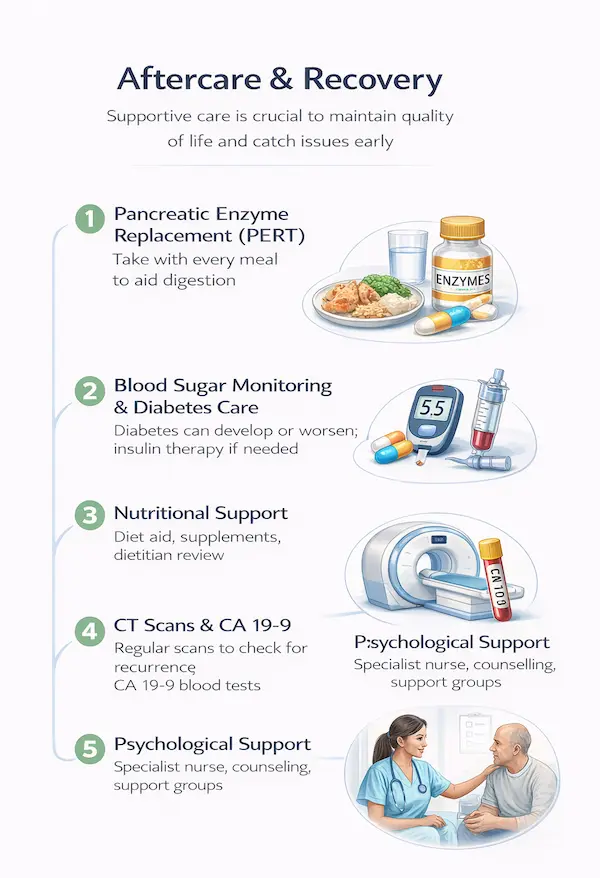
    Enzyme supplements are not optional after pancreatic surgery — without them, food passes through undigested, causing weight loss, fatty stools, and fatigue. Take them with every meal and snack, every time.
  • Your guide to Gallbladder Cancer, Everything You Need to Know

    Your guide to Gallbladder Cancer, Everything You Need to Know

    PancreaCare by
    Advitya Healthcares

    Covering: Oesophageal  |  Stomach  |  Liver  |  Gallbladder  |  Bile Duct
    Pancreatic  |  Small Bowel  |  Colon  |  Rectal  |  Anal  |  GIST  |  NETs

    Warning Signs: When to See a Doctor

    Red Flag Symptoms — Never Ignore These    
    Unexplained weight loss or loss of appetite   Difficulty swallowing or pain when swallowing   Persistent indigestion, heartburn, or abdominal pain   Vomiting blood, or vomit that looks like coffee grounds   Black, tarry, or bloody stools   New jaundice — yellowing of skin or whites of the eyes   Dark urine and pale/clay-coloured stools   A change in bowel habits lasting more than 3 weeks   Unexplained new anaemia (low blood count)   New-onset diabetes after age 50, especially with weight loss   A lump or swelling in the abdomen   If you have any of these — please make an appointment with your GP today. Early detection genuinely saves lives.

    Gallbladder Cancer

    Advitya Healthcares

    What Is It?

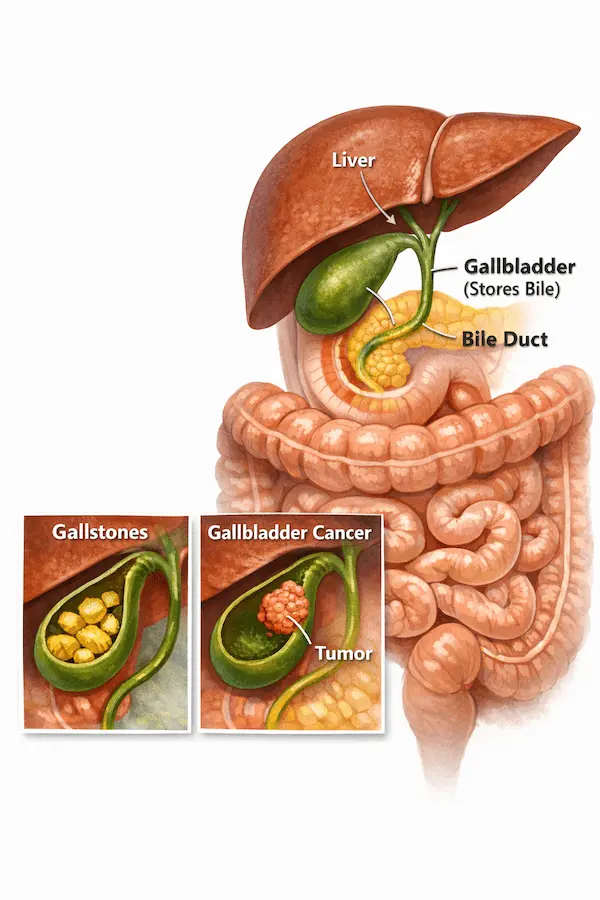
    The gallbladder is a small pear-shaped pouch tucked beneath the liver. Its job is to store bile — a digestive fluid made by the liver — and release it into the small intestine after meals to help digest fats.

    Gallbladder cancer is not common, but it’s important to know about because it’s often linked to gallstones, which are very common. It tends to be found at a later stage because it rarely causes distinct symptoms early on.

    Why Does It Happen? (Causes & Risk Factors)

    Advitya healthcares

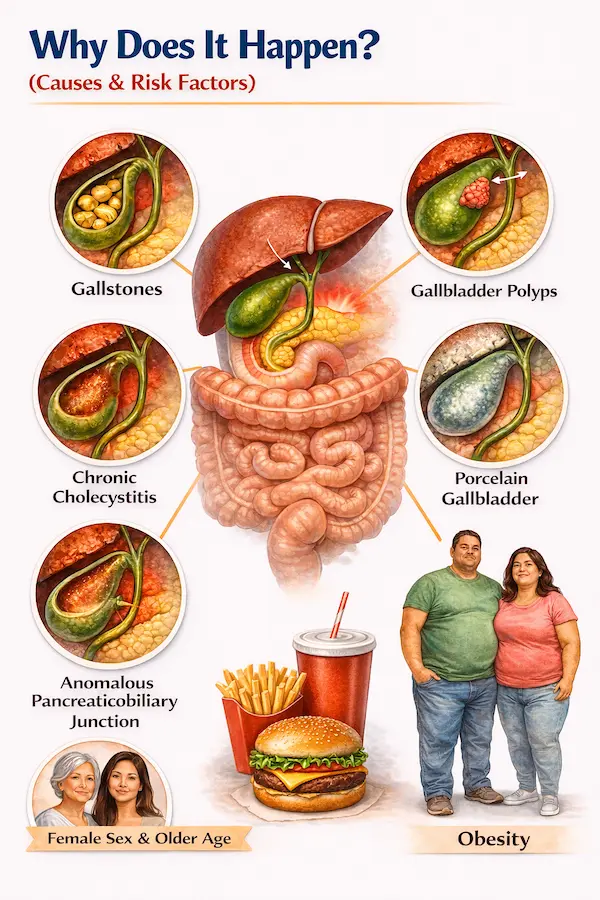
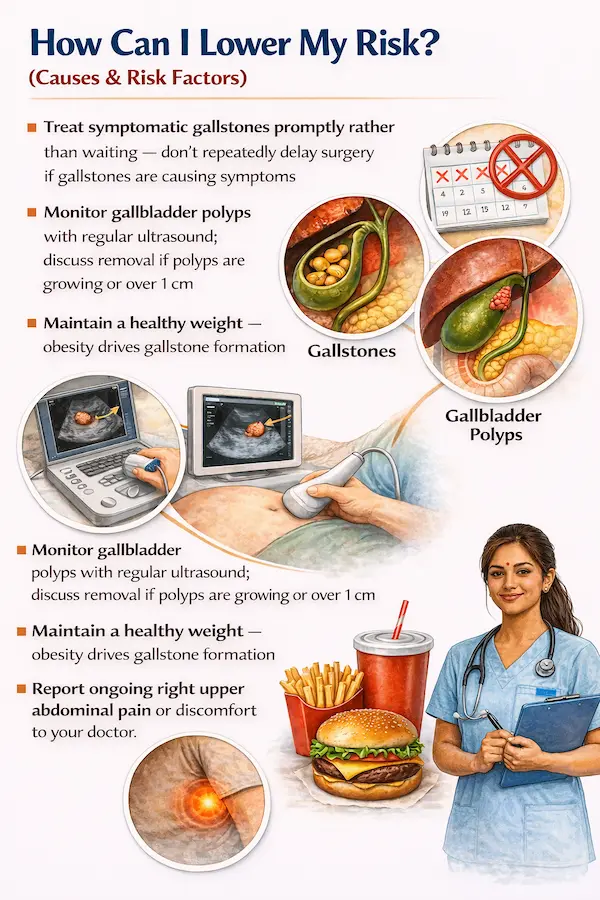
    The common thread in gallbladder cancer is chronic inflammation and irritation of the gallbladder wall:

    • Gallstones (cholelithiasis) — especially large stones causing repeated episodes of inflammation
    • Chronic cholecystitis (long-standing gallbladder inflammation)
    • Gallbladder polyps — particularly those larger than 1 cm
    • Porcelain gallbladder (calcification of the gallbladder wall from chronic inflammation)
    • Anomalous pancreaticobiliary junction (a structural abnormality where bile duct joins the pancreatic duct abnormally)
    • Female sex and older age
    • Obesity and certain ethnic backgrounds (higher rates in some South American and South Asian populations)

    How Can I Lower My Risk?

    Advitya healthcares

    How Is It Diagnosed?

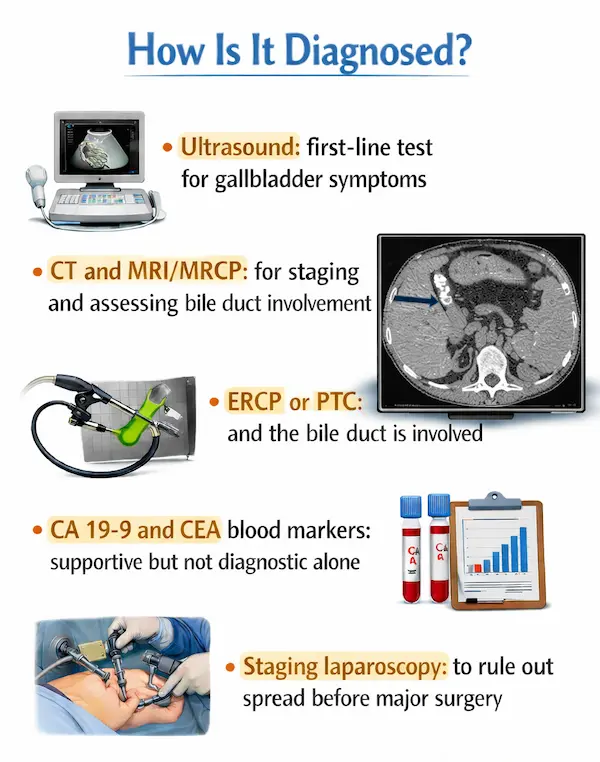
    Gallbladder cancer is often suspected on imaging done for other reasons, or when gallbladder removal (cholecystectomy) reveals unexpected cancer:

    Advitya healthcares

    How Is It Treated?

    Surgery offers the only chance of cure; the extent depends on how far the cancer has spread:

    • Simple cholecystectomy: removal of the gallbladder alone — sufficient for very early incidental cancers
    • Extended cholecystectomy: removal of the gallbladder plus a margin of liver and nearby lymph nodes — for most operable cancers
    • Bile duct resection: if the bile duct is involved
    • Chemotherapy (gemcitabine + cisplatin or capecitabine) after surgery or for advanced disease
    • Stent placement: to relieve jaundice caused by bile duct blockage in advanced cases
    The Surgery: Extended Cholecystectomy For most operable gallbladder cancers, surgery involves removing the gallbladder, a wedge of liver tissue immediately adjacent to it, and lymph nodes in the nearby region. If the bile duct is involved, that section of bile duct is also removed and the bowel is reconnected (biliary reconstruction). The goal is complete removal of all cancer with clear margins. Hospital stay is typically 5-10 days depending on complexity.

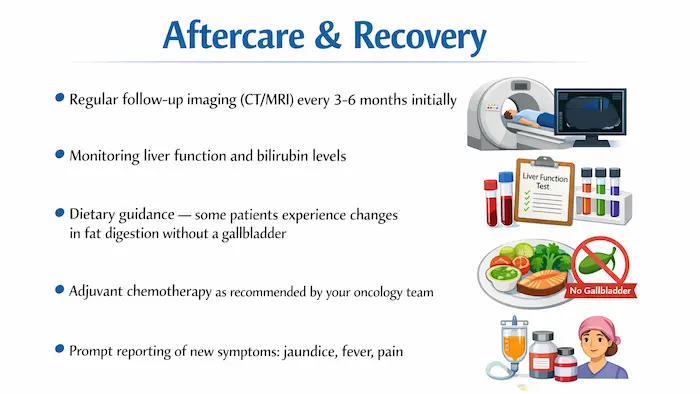
    Aftercare & Recovery

    Advitya Healthcares
  • Your guide to Liver Cancer, Everything You Need to Know

    Your guide to Liver Cancer, Everything You Need to Know

    PancreaCare by
    Advitya Healthcares

    Covering: Oesophageal  |  Stomach  |  Liver  |  Gallbladder  |  Bile Duct
    Pancreatic  |  Small Bowel  |  Colon  |  Rectal  |  Anal  |  GIST  |  NETs

    Warning Signs: When to See a Doctor

    Red Flag Symptoms — Never Ignore These    
    Unexplained weight loss or loss of appetite   Difficulty swallowing or pain when swallowing   Persistent indigestion, heartburn, or abdominal pain   Vomiting blood, or vomit that looks like coffee grounds   Black, tarry, or bloody stools   New jaundice — yellowing of skin or whites of the eyes   Dark urine and pale/clay-coloured stools   A change in bowel habits lasting more than 3 weeks   Unexplained new anaemia (low blood count)   New-onset diabetes after age 50, especially with weight loss   A lump or swelling in the abdomen   If you have any of these — please make an appointment with your GP today. Early detection genuinely saves lives.

    Liver Cancer (Hepatocellular Carcinoma)

    What Is It?

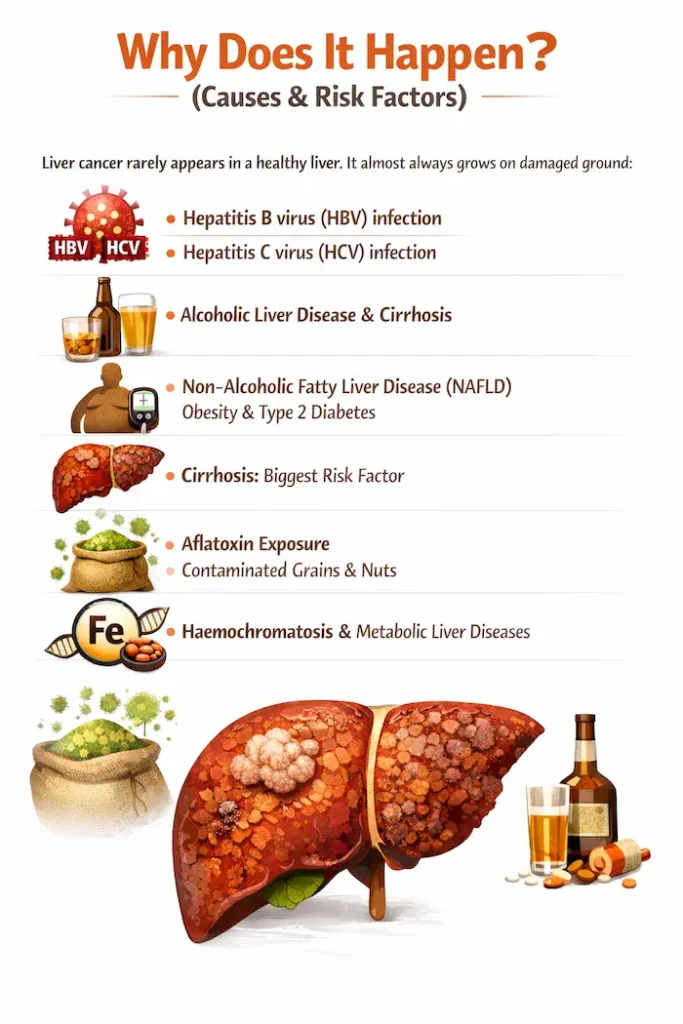
    Why Does It Happen? (Causes & Risk Factors)

    advitya healthcares

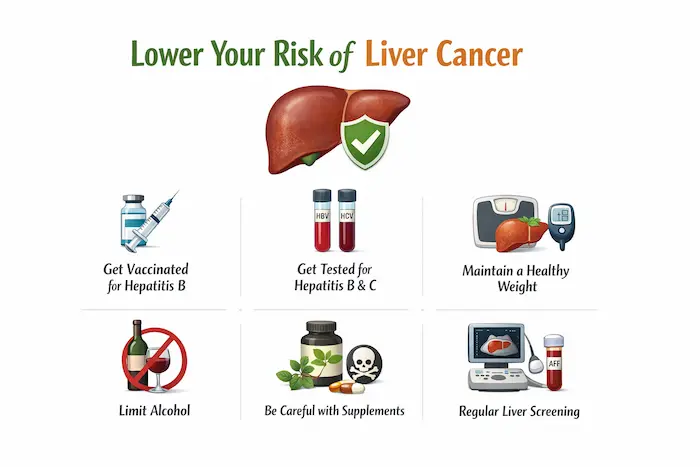
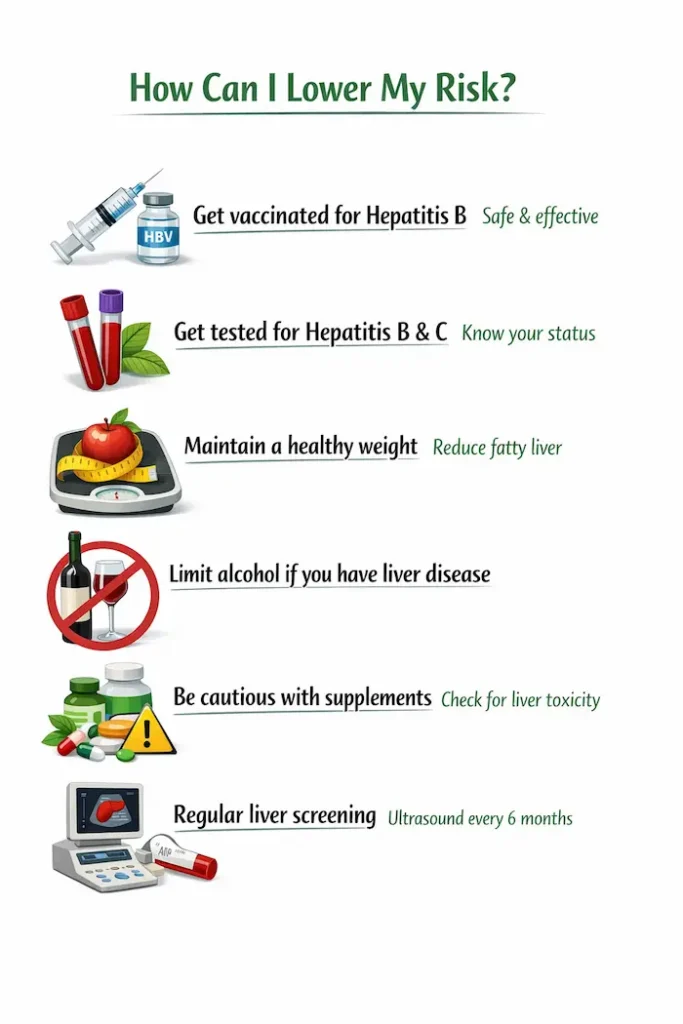
    How Can I Lower My Risk?

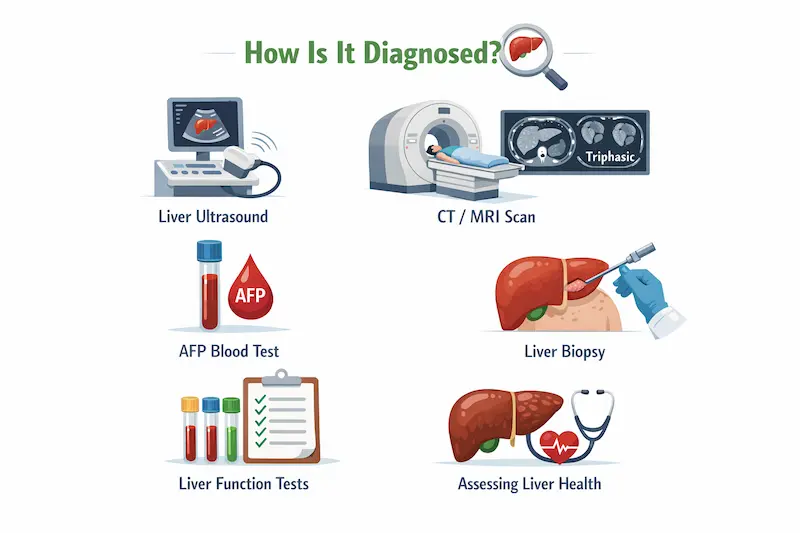
    How Is It Diagnosed?

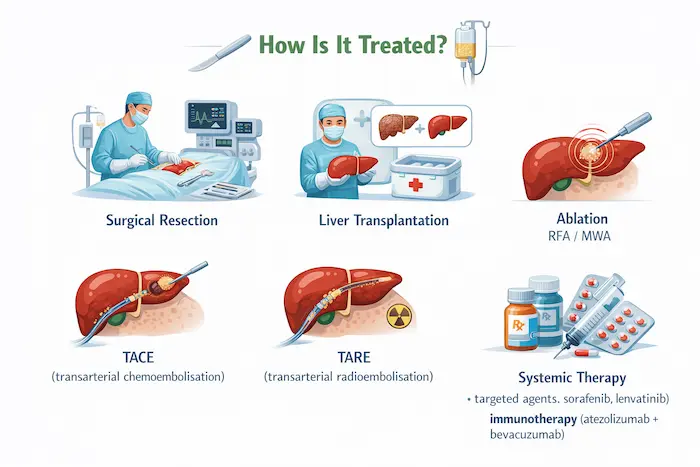
    How Is It Treated?

    The Surgery: Liver Resection (Hepatectomy) A hepatectomy removes the tumour along with a margin of healthy liver tissue. The liver has a unique ability to regenerate — up to 70% can be safely removed in a healthy liver. In cirrhotic livers, the extent of surgery is carefully limited based on liver reserve. The operation can be done open or laparoscopically (keyhole). Hospital stay is typically 4-7 days. Liver Transplantation: Both the cancerous liver and the diseased underlying liver are removed and replaced with a healthy donor liver — offering the best long-term outcomes for eligible patients.

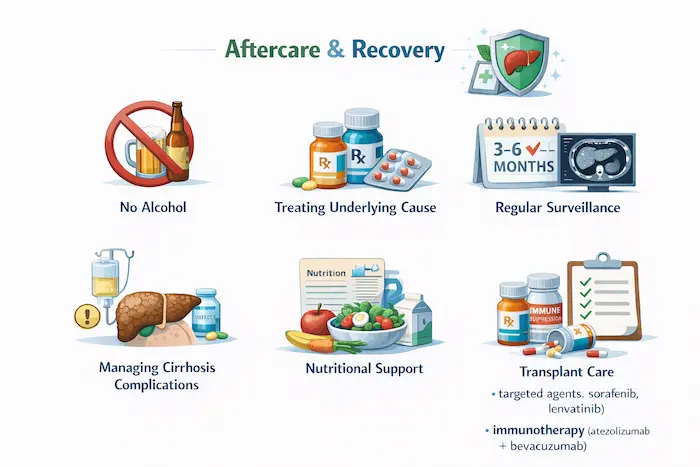
    Aftercare & Recovery

  • Your guide to Stomach Cancer, Everything You Need to Know

    Your guide to Stomach Cancer, Everything You Need to Know

    PancreaCare by
    Advitya Healthcares

    Covering: Oesophageal  |  Stomach  |  Liver  |  Gallbladder  |  Bile Duct
    Pancreatic  |  Small Bowel  |  Colon  |  Rectal  |  Anal  |  GIST  |  NETs

    Warning Signs: When to See a Doctor

    Red Flag Symptoms — Never Ignore These    
    Unexplained weight loss or loss of appetite   Difficulty swallowing or pain when swallowing   Persistent indigestion, heartburn, or abdominal pain   Vomiting blood, or vomit that looks like coffee grounds   Black, tarry, or bloody stools   New jaundice — yellowing of skin or whites of the eyes   Dark urine and pale/clay-coloured stools   A change in bowel habits lasting more than 3 weeks   Unexplained new anaemia (low blood count)   New-onset diabetes after age 50, especially with weight loss   A lump or swelling in the abdomen   If you have any of these — please make an appointment with your GP today. Early detection genuinely saves lives.

    Stomach Cancer – Gastric Cancer

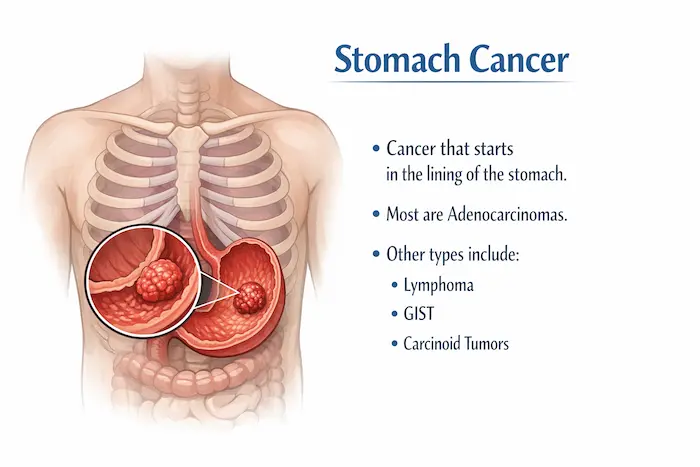
    What Is It?

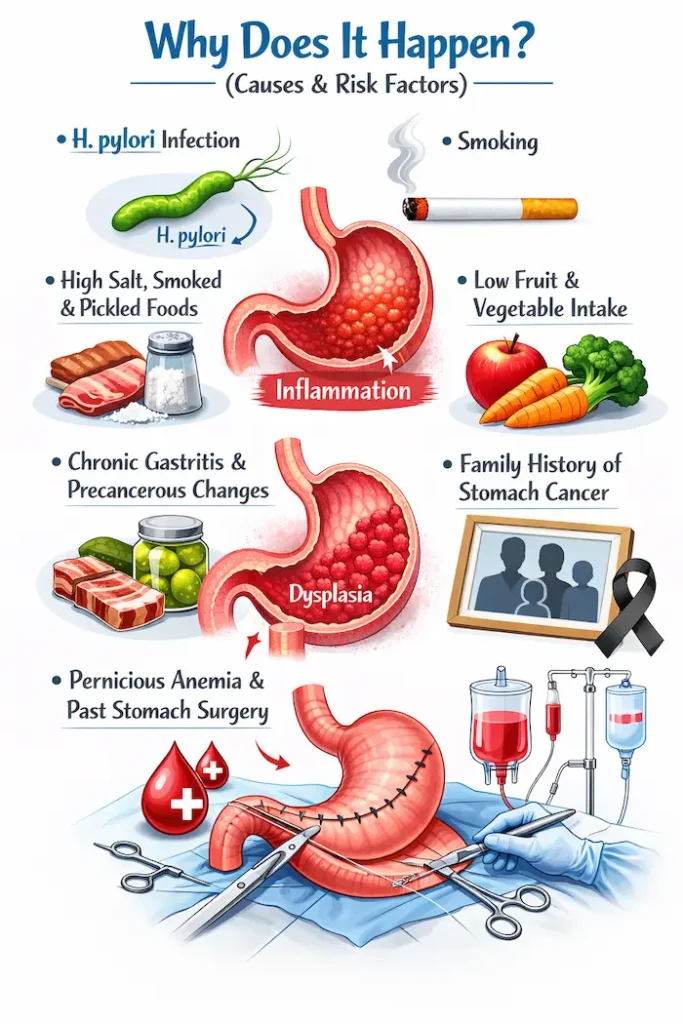
    stomach cancer

    Why Does It Happen? (Causes & Risk Factors)

    stomach cancer

    How Can I Lower My Risk?

    stomach cancer

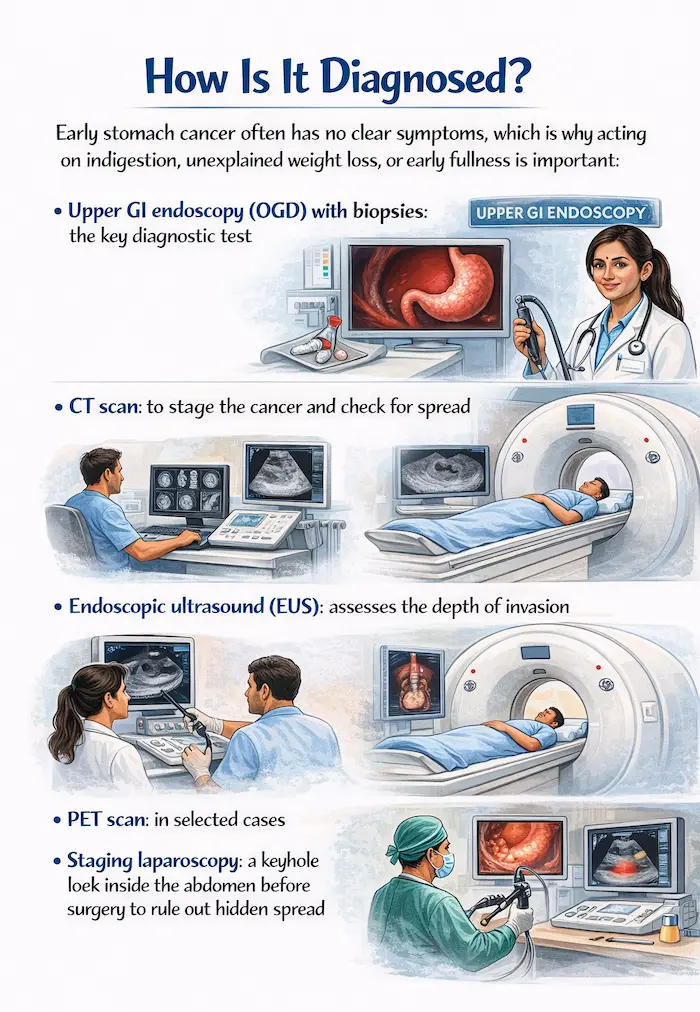
    How Is It Diagnosed?

    how is tomach cancer diagnosed

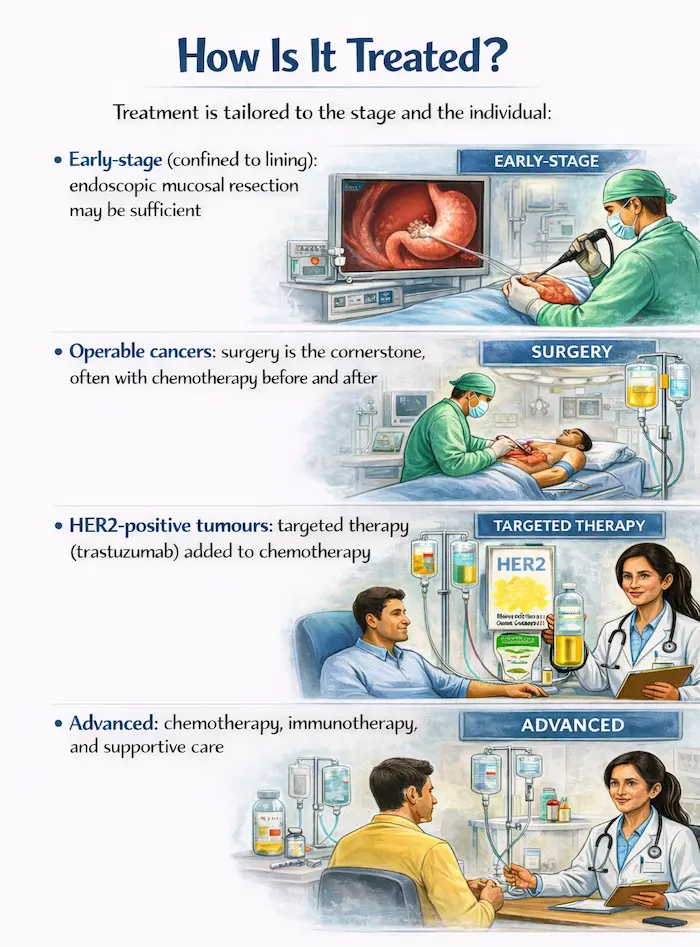
    How Is It Treated?

    how is stomach cancer treated at advitya healthcares
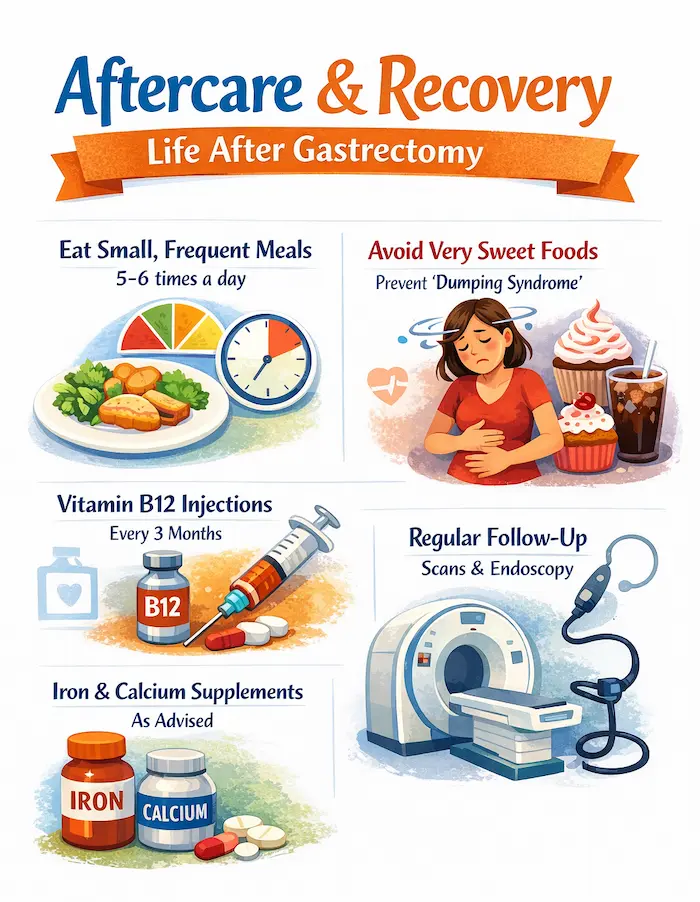
    The Surgery: Gastrectomy A gastrectomy removes part (partial) or all (total) of the stomach, along with nearby lymph nodes. Partial gastrectomy: removes the lower part of the stomach; the remainder is reconnected to the small bowel. Total gastrectomy: the entire stomach is removed; the oesophagus is connected directly to the small bowel. Both operations are typically done by keyhole surgery where possible. The operation takes 3-6 hours. Hospital stay is around 7-10 days.

    Aftercare & Recovery

    after care for stomach cancer
    Dumping syndrome — feeling flushed, sweaty, or unwell soon after eating — is common after stomach surgery but usually improves with dietary changes. Your dietitian will guide you through what to eat and what to avoid.
  • Your guide to  Oesophageal Cancer, Everything You Need to Know

    Your guide to Oesophageal Cancer, Everything You Need to Know

    PancreaCare by
    Advitya Healthcares

    Covering: Oesophageal  |  Stomach  |  Liver  |  Gallbladder  |  Bile Duct
    Pancreatic  |  Small Bowel  |  Colon  |  Rectal  |  Anal  |  GIST  |  NETs

    Warning Signs: When to See a Doctor

    Red Flag Symptoms — Never Ignore These    
    Unexplained weight loss or loss of appetite   Difficulty swallowing or pain when swallowing   Persistent indigestion, heartburn, or abdominal pain   Vomiting blood, or vomit that looks like coffee grounds   Black, tarry, or bloody stools   New jaundice — yellowing of skin or whites of the eyes   Dark urine and pale/clay-coloured stools   A change in bowel habits lasting more than 3 weeks   Unexplained new anaemia (low blood count)   New-onset diabetes after age 50, especially with weight loss   A lump or swelling in the abdomen   If you have any of these — please make an appointment with your GP today. Early detection genuinely saves lives.

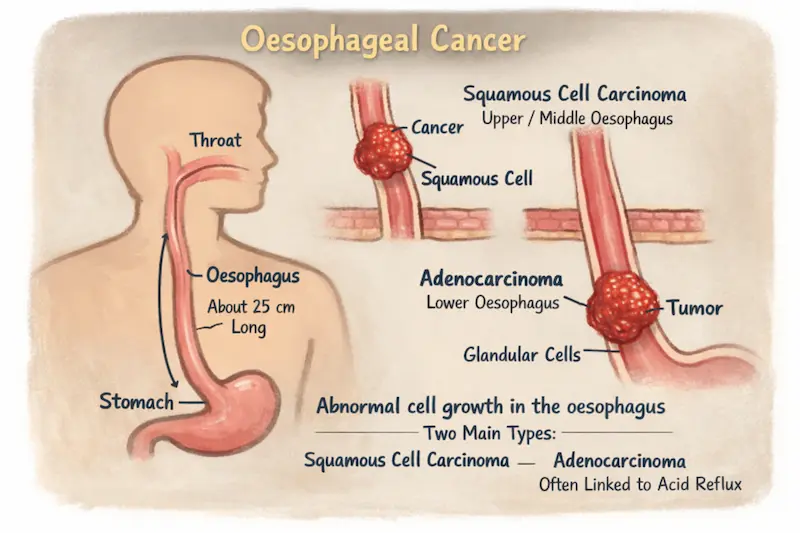
    1. Oesophageal Cancer

    ChatGPT Image Feb 21, 2026, 05 02 04 PM

    What Is It?

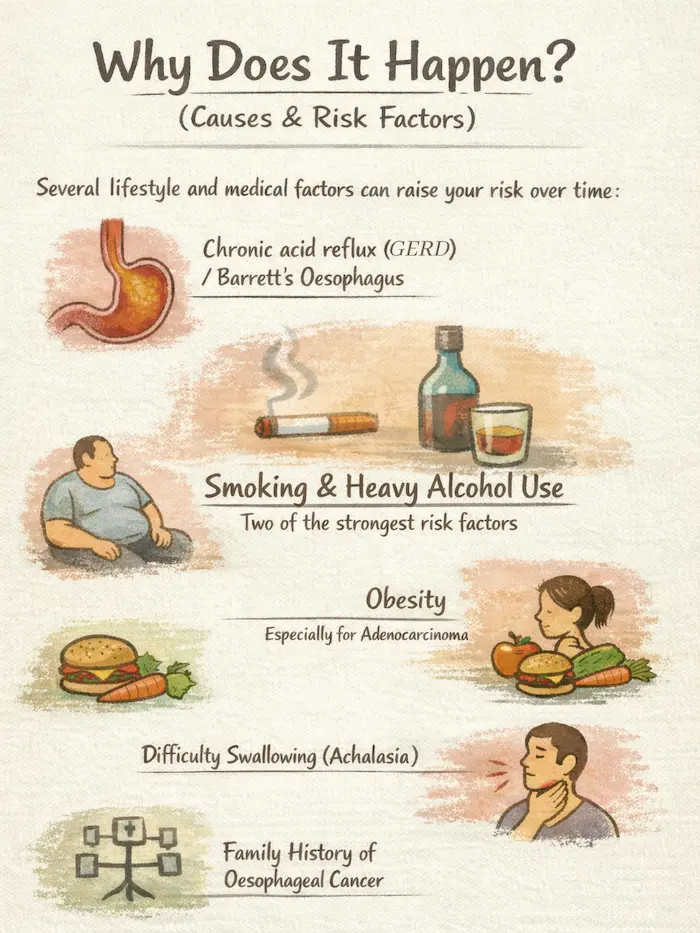
    Why Does It Happen?
    (Causes & Risk Factors)

    GERD

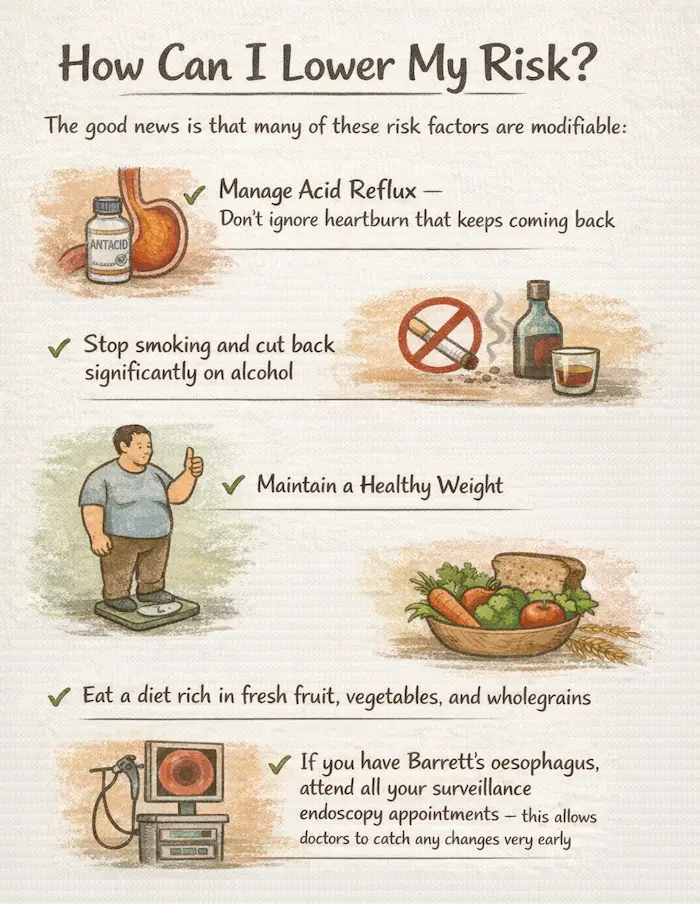
    How Can I Lower My Risk?

    ChatGPT Image Feb 21, 2026, 05 13 36 PM
    Barrett’s Oesophagus: Know Your Status If you’ve had long-standing acid reflux, ask your GP about a check for Barrett’s oesophagus. This pre-cancerous change can be monitored closely and treated before cancer develops — it’s a genuine opportunity to stop cancer in its tracks.

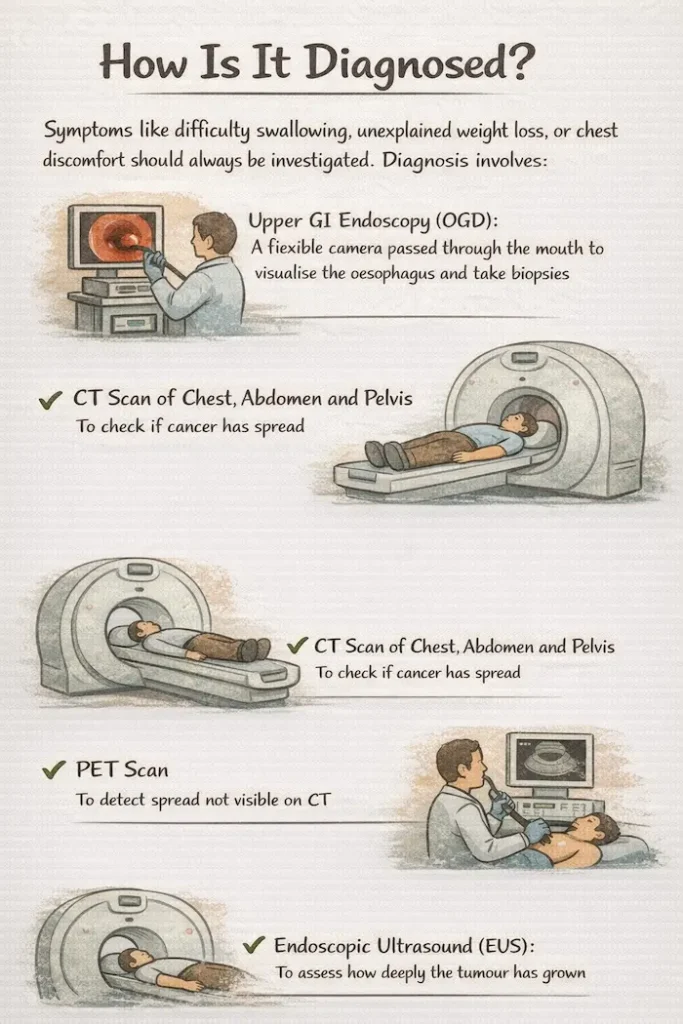
    How Is It Diagnosed?

    ChatGPT Image Feb 21, 2026, 05 21 31 PM

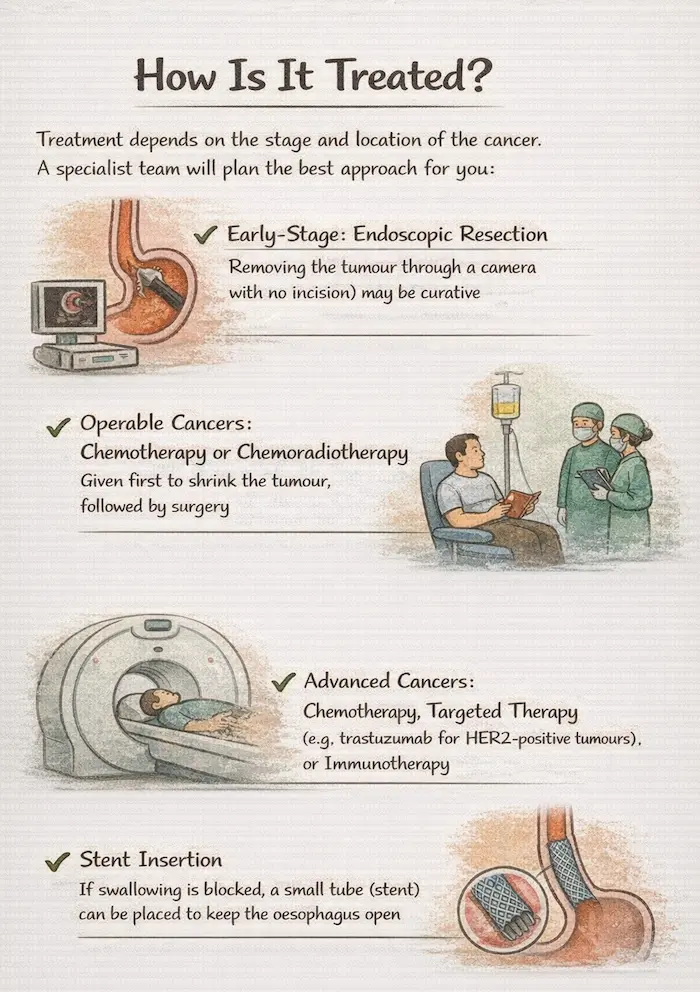
    How Is It Treated?

    ChatGPT Image Feb 21, 2026, 05 23 43 PM
    The Surgery: Oesophagectomy An oesophagectomy removes the affected part of the oesophagus and sometimes the top of the stomach, along with nearby lymph nodes. The stomach is then pulled up into the chest or neck and reconnected — essentially becoming the new oesophagus. It is a major operation typically done using keyhole (minimally invasive) techniques where possible. Most patients stay in hospital for 7-14 days. Recovery at home takes several weeks, with gradual return to eating.

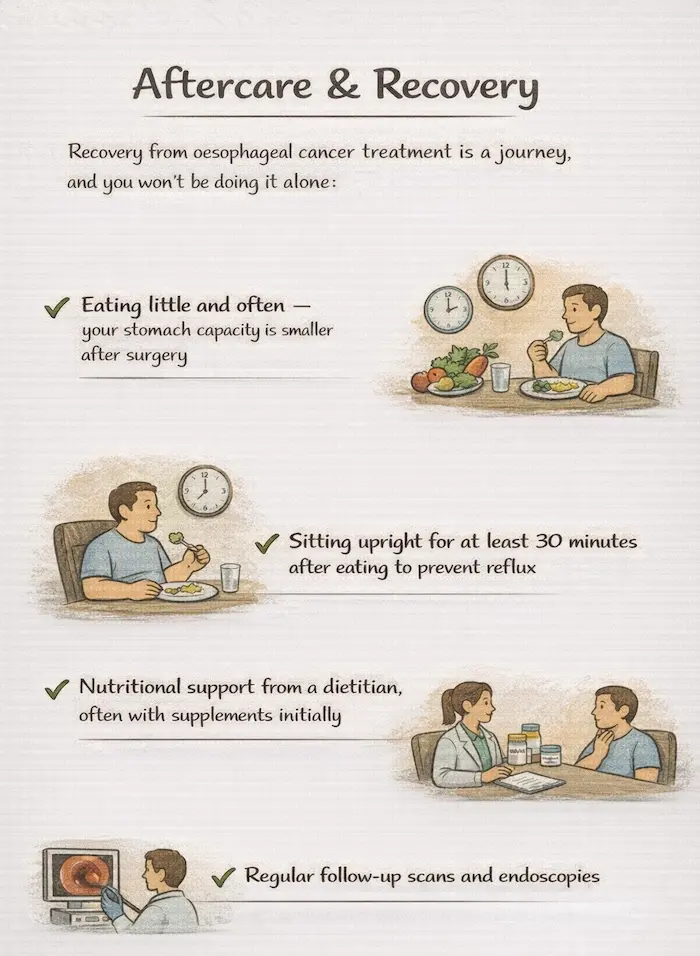
    Aftercare & Recovery

    ChatGPT Image Feb 21, 2026, 05 25 46 PM

    Recovery from oesophageal cancer treatment is a journey, and you won’t be doing it alone:

    • Eating little and often — your stomach capacity is smaller after surgery
    • Sitting upright for at least 30 minutes after eating to prevent reflux
    • Nutritional support from a dietitian, often with supplements initially
    • Regular follow-up scans and endoscopies
    • Speech and swallowing therapy if needed
    Many people are surprised by how well they adapt after oesophageal surgery. A specialist dietitian and a structured rehab plan make an enormous difference — don’t hesitate to ask for support.
  • Fatty Liver + Belly Fat: The Gut–Liver Connection Behind “Stubborn Weight

    Fatty Liver + Belly Fat: The Gut–Liver Connection Behind “Stubborn Weight

    PancreaCare by Advitya Healthcares

    If you’re in Kolkata and feeling like your belly fat won’t budge—even after cutting calories or walking every day—you’re not alone. Many people do “everything right” on the surface, yet the scale barely moves, the waistline stays the same, and fatigue keeps creeping in.

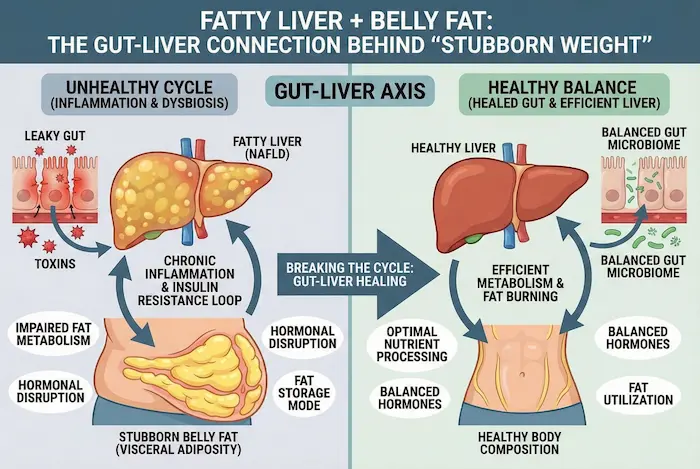
    One common (and often missed) reason: fatty liver + visceral (deep belly) fat, driven by a powerful internal loop called the gut–liver axis. In simple words: your gut, liver, and metabolism talk to each other all day. When that communication turns unhealthy, your body becomes more likely to store fat—especially around the abdomen—and less likely to burn it efficiently.

    This blog explains the gut–liver connection behind stubborn belly fat in a practical, Kolkata-friendly way.


    1) Fatty Liver + Belly Fat: Why They Often Come Together

    What is fatty liver?

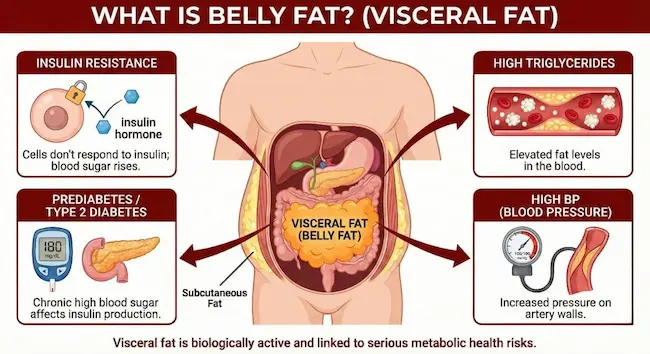
    Fatty liver (commonly NAFLD / MASLD) means excess fat gets stored inside liver cells. It can happen even if you don’t drink alcohol. It’s strongly linked with:

    5171f1a6 521f 42d2 a9ff a799027a7822
    • Belly fat (visceral fat)
    • Insulin resistance
    • High triglycerides
    • Prediabetes / Type 2 diabetes
    • High BP

    Why belly fat is “different fat”

    Belly fat isn’t just “extra weight.” Visceral fat sits deep around internal organs and behaves like an active hormone gland. It releases inflammatory signals that make:

    • insulin resistance worse
    • fatty liver worse
    • cravings and hunger regulation worse

    So fatty liver and belly fat often form a two-way cycle.


    2) The Gut–Liver Axis: The Hidden Metabolic Highway

    Your gut and liver are connected through the portal vein—a direct route that carries nutrients, bacteria by-products, and inflammatory compounds from intestines straight to the liver.

    When the gut environment is balanced, the liver receives mostly “safe” signals.
    When the gut is disturbed, the liver receives more:

    • inflammatory compounds
    • bacterial toxins (endotoxins)
    • excess sugar/fat metabolites

    This can trigger:

    • fat storage in liver
    • inflammation in liver
    • reduced fat-burning
    • more stubborn belly fat

    3) How Gut Problems Can Drive Fatty Liver & Stubborn Weight

    A) Dysbiosis (unhealthy gut microbiome)

    If “good bacteria” reduce and “harmful bacteria” increase, the body may:

    • extract more calories from the same food
    • increase inflammation
    • worsen insulin resistance

    B) Leaky gut (increased intestinal permeability)

    When the gut lining becomes more permeable, inflammatory particles can enter circulation and reach the liver, increasing:

    • liver inflammation
    • fat accumulation
    • metabolic slowdown

    C) Bloating, acidity, irregular bowel movements → not just “gas”

    In many Kolkata lifestyles (late dinners, tea + biscuits, weekend biryani, sweets), the gut can remain irritated—leading to cravings, poor sleep, and hormonal imbalance that indirectly pushes fat storage.


    4) Insulin Resistance: The Core Link Between Fatty Liver and Belly Fat

    Insulin is the hormone that moves glucose into cells.
    When the body becomes resistant to insulin:

    • blood sugar stays higher
    • the pancreas produces more insulin
    • high insulin pushes the body to store fat, especially visceral fat
    • liver converts excess glucose into fat (fatty liver)

    Key point: You can have insulin resistance even with “normal weight,” but it’s very common with belly fat.


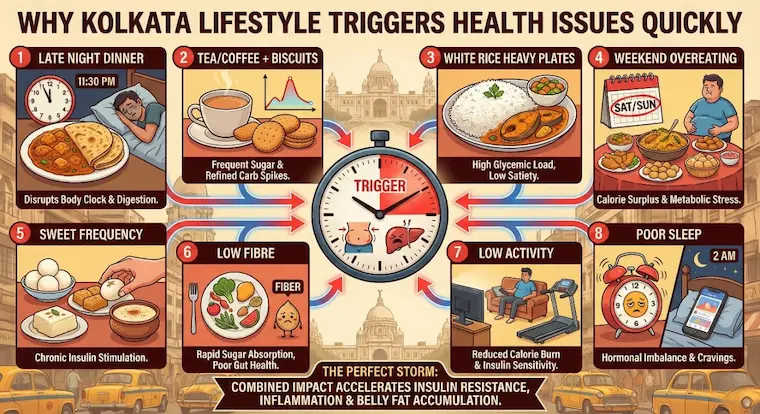
    5) Kolkata Lifestyle Triggers That Quietly Worsen the Gut–Liver Loop

    These are common patterns we see locally (no guilt—just awareness):

    3131e385 c214 4248 acfc 381bf42c5b06 (1)
    • Late-night dinner (after 9 pm) + sleeping soon after
    • Tea/coffee + biscuits multiple times daily (hidden sugar + refined flour)
    • White rice-heavy plates with low protein
    • Weekend overeating (biryani, rolls, fried snacks)
    • Sweet frequency (mishti, packaged sweets, desserts)
    • Low fiber (less vegetables/whole grains)
    • Low activity outside of work + long sitting hours
    • Poor sleep and high stress

    These don’t just add calories—they disrupt gut bacteria, insulin response, and liver fat metabolism.


    6) Signs That “Stubborn Weight” Might Be a Fatty Liver + Gut Issue

    Many people don’t feel anything early. But common clues include:

    • belly fat increasing even without big weight gain
    • constant fatigue / low energy
    • cravings, especially evening sugar cravings
    • bloating, acidity, irregular bowel habits
    • borderline high sugar (prediabetes) or triglycerides
    • mildly elevated liver enzymes (ALT/AST)
    • snoring/sleep issues (often linked with visceral fat)

    Important: Only a clinician can confirm diagnosis. But these signs can be a reason to get checked.


    7) What Tests Usually Help (Doctor-guided)

    Depending on your history, a doctor may advise:

    • LFT (liver function tests)
    • Ultrasound abdomen (fatty liver grading)
    • Fasting glucose, HbA1c
    • Fasting insulin / HOMA-IR (in selected cases)
    • Lipid profile (especially triglycerides)
    • Thyroid profile (if indicated)
    • Fibrosis assessment (FibroScan or non-invasive scoring) if risk is high

    8) The Fix: Heal the Gut–Liver Loop (Not Just “Eat Less”)

    The best strategy is not crash dieting. It’s metabolic correction.

    A) Build a “liver-friendly plate” (simple)

    Aim each meal to have:

    • Protein: fish/egg/chicken/dal/paneer/curd
    • Fiber: vegetables + salads
    • Smart carbs: controlled rice/roti portion
    • Healthy fats: small amounts (mustard oil, nuts)

    Rule that works:
    ½ plate vegetables + ¼ protein + ¼ carbs

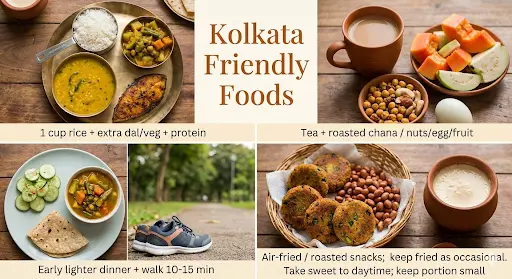
    B) Kolkata-friendly food swaps (practical)

    1769081101195 (1)
    If you usually eat…Try this instead…
    2–3 cups white rice1 cup rice + extra dal/veg + protein
    Tea + biscuits dailyTea + roasted chana / nuts / egg / fruit
    Late heavy dinnerEarly lighter dinner + walk 10–15 min
    Fried snacks oftenAir-fried / roasted snacks; keep fried as occasional
    Sweets after dinnerShift sweet to daytime; keep portion small

    C) Improve gut bacteria (simple habits)

    • Add curd (dahi) if tolerated
    • Add fiber slowly (veg, oats, chia, seeds)
    • Include fermented foods in small amounts if suitable
    • Reduce ultra-processed foods (packaged snacks, sugary drinks)

    (If you have IBS, acidity, or food intolerances, don’t self-experiment aggressively—personalized guidance helps.)

    D) Walking is good, but add strength (belly fat responds faster)

    To reduce visceral fat, add strength training 3x/week (even at home):

    • squats, lunges, push-ups (modified), resistance bands
    • 20–30 minutes is enough to start

    Strength training improves:

    • insulin sensitivity
    • muscle mass (metabolic engine)
    • fat burning even at rest

    E) Sleep & stress (underrated but crucial)

    Poor sleep increases:

    • hunger hormones
    • sugar cravings
    • insulin resistance

    Kolkata-friendly tip:
    Try a “closing routine” after dinner:
    10–15 min walk + warm water + screens off 30–45 min before bed.


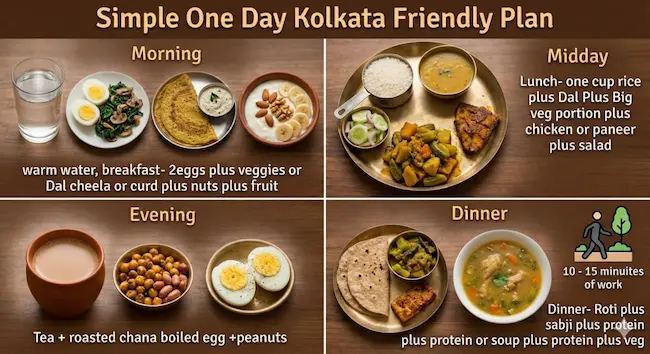
    9) A Sample 1-Day Kolkata-Friendly Plan (Easy to Follow)

    WhatsApp Image 2026 01 22 at 4.20.20 PMd

    Morning

    • Warm water
    • Breakfast: 2 eggs + veggies / or dal cheela / or curd + nuts + fruit (small portion)

    Midday

    • Lunch: 1 cup rice + dal + big veg portion + fish/chicken/paneer
    • Optional: salad

    Evening

    • Tea + roasted chana / boiled egg / peanuts (not biscuits daily)

    Night (early)

    • Dinner: roti + sabzi + protein OR soup + protein + veg
    • 10–15 min walk

    Weekly rule: Keep biryani/roll/mishti—just make it planned, not random and frequent.


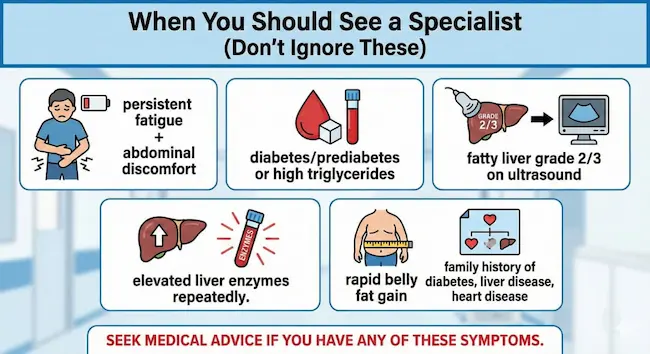
    10) When You Should See a Specialist (Don’t Ignore These)

    Seek medical advice if you have:

    • persistent fatigue + abdominal discomfort
    • diabetes/prediabetes or high triglycerides
    • fatty liver grade 2/3 on ultrasound
    • elevated liver enzymes repeatedly
    • rapid belly fat gain
    • family history of diabetes, liver disease, heart disease
    WhatsApp Image 2026 01 22 at 4.28.34 PM

    PancreaCare by Advitya Healthcares (Kolkata Focus): How We Help

    At PancreaCare by Advitya Healthcares, we focus on gut–liver–metabolic health with a structured approach—so you’re not stuck doing random diets.

    A doctor-guided plan may include:

    • understanding your fatty liver risk and metabolic profile
    • identifying gut triggers (bloating, acidity, bowel irregularity)
    • lifestyle + nutrition guidance that fits Kolkata food habits
    • monitoring liver health and preventing progression

    If your “stubborn weight” is really a gut–liver issue, the solution is not punishment—it’s correction.


    FAQ (Quick Answers)

    1) Can fatty liver happen if I don’t drink alcohol?
    Yes. Non-alcoholic fatty liver is very common and often linked to belly fat and insulin resistance.

    2) Can I reduce fatty liver without losing a lot of weight?
    Often, yes. Even 5–10% weight reduction and better insulin sensitivity can significantly improve liver fat.

    3) Is rice completely banned in fatty liver?
    Not necessarily. Portion control + protein + vegetables matters more than “zero rice.”

    4) Does bloating mean fatty liver?
    Not always. But gut disturbance and fatty liver can coexist and worsen each other.


    Medical Disclaimer

    This blog is for general awareness and does not replace medical consultation, diagnosis, or treatment. If you have persistent symptoms or abnormal test reports, please consult a qualified doctor.

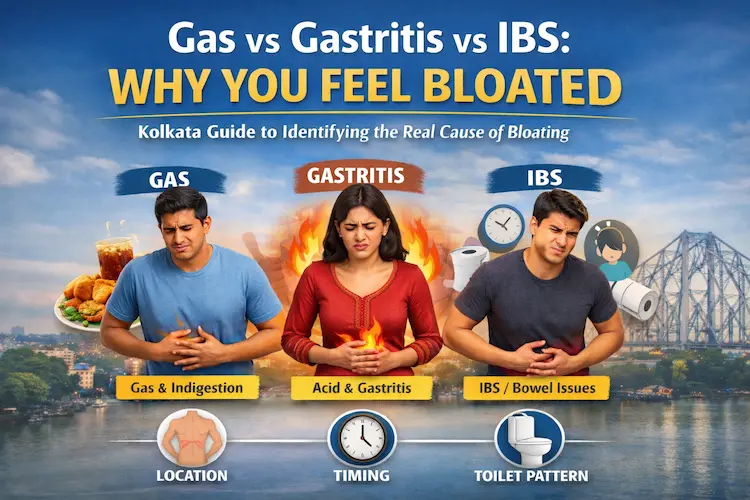
  • Gas vs Gastritis vs IBS: How to Identify the Real Cause of Bloating (Simple Kolkata Guide)

    Gas vs Gastritis vs IBS: How to Identify the Real Cause of Bloating (Simple Kolkata Guide)

    Bloating is one of the most common “everyday” problems in Kolkata—especially with irregular meal timings, late-night tea, street food cravings, and stress. The issue is that bloating can mean very different things depending on why it’s happening.

    Most people label everything as “gas,” but the real cause is often one of these three:

    1. Simple Gas / Indigestion (diet + lifestyle related)
    2. Gastritis (stomach lining irritation/inflammation, sometimes due to acid or infection)
    3. IBS (Irritable Bowel Syndrome—gut-brain sensitivity + bowel pattern changes)

    This guide helps you identify which bucket you’re likely in—so you stop guessing and start managing it correctly.


    First: What does “bloating” actually mean?

    People use “bloating” for different sensations:

    • Fullness after eating (stomach feels heavy)
    • Visible abdominal swelling (tight waistband by evening)
    • Burping and upper gas (more in chest/upper belly)
    • Lower belly gas with stool changes (constipation/loose motions)
    • Burning + sour burps (acid-related)

    Where you feel it + when it happens is the biggest clue.


    Quick Kolkata Self-Check (30 seconds)

    Answer these honestly:

    A) Mostly upper belly? (above the navel)

    • More burping than passing gas
    • Burning/acidic sensation
    • Worse with tea/coffee, spicy food, late dinner
      ➡️ Likely Gastritis / Acid-related

    B) Mostly lower belly? (below the navel)

    • Tightness by evening
    • Stool changes (constipation/diarrhea)
    • Worse with stress, anxiety, irregular routine
      ➡️ Likely IBS

    C) Mostly after a specific meal?

    • Happens after heavy meals, oily food, fast eating
    • Gets better with walking, time, simple diet
    • No consistent stool pattern change
      ➡️ Likely Simple Gas / Indigestion

    Now let’s break it down properly.


    1) Simple Gas / Indigestion: The “food + speed + timing” problem

    ChatGPT Image Jan 16, 2026, 05 25 34 PM

    Common Kolkata triggers

    • Fast eating (office lunch in 10 minutes)
    • Overeating at night (biryani/roll + tea)
    • Too much fried food (telebhaja, chop, pakora)
    • Excess carbonated drinks
    • Too much onion/garlic for sensitive stomachs
    • Skipping meals, then heavy dinner

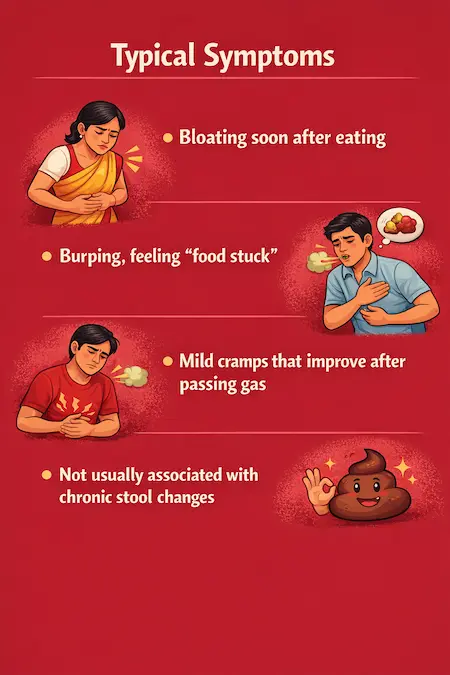
    Typical symptoms

    • Bloating soon after eating
    • Burping, feeling “food stuck”
    • Mild cramps that improve after passing gas
    • Not usually associated with chronic stool changes

    What helps (simple + effective)

    • Eat slower (put spoon down between bites)
    • 10–15 min walk after meals
    • Lighter dinner, earlier dinner
    • Reduce oily + deep-fried foods for 7 days
    • Try smaller portions of known gas-producers (peas, cabbage, cauliflower)

    If this fixes it, you were likely dealing with indigestion-related gas.


    2) Gastritis: When the stomach lining is irritated

    Gastritis is not just “acidity.” It can be triggered by spicy foods and stress—but also by painkillers (NSAIDs), alcohol, smoking, or H. pylori infection in some cases.

    Typical symptoms

    • Burning or discomfort in upper abdomen
    • Nausea, reduced appetite
    • Sour burps, heartburn, chest discomfort
    • Bloating feels like “tightness” in the upper stomach
    • Sometimes worse on an empty stomach (or after very spicy food)

    Red flags that point more toward gastritis than “gas”

    • You feel better temporarily after antacids—but it keeps returning
    • Night-time acidity affecting sleep
    • Frequent burning sensation, not just fullness

    What helps (do this for 7–10 days)

    • Avoid late-night tea/coffee
    • Cut down very spicy gravies, vinegar sauces, heavy tomato at night
    • Don’t lie down immediately after meals (give 2–3 hours)
    • Avoid self-medicating painkillers without guidance
    • If symptoms persist >2–3 weeks, you may need evaluation (sometimes tests for H. pylori, or endoscopy based on symptoms)

    3) IBS: When the gut becomes “extra sensitive” (and stress matters)

    IBS is very common, and many people live with it for years thinking it’s “gas.” IBS is not dangerous like cancer, but it can seriously affect quality of life and needs structured management.

    Typical IBS pattern

    • Bloating that often builds up by evening
    • Lower belly discomfort
    • Symptoms linked to stress, anxiety, irregular sleep
    • Bowel pattern changes, such as:
      • IBS-C: constipation, hard stool, incomplete evacuation
      • IBS-D: loose motions, urgency
      • IBS-M: mix of both

    IBS clue (important)

    If your bloating is consistently tied to stool pattern changes and stress, IBS becomes more likely than simple indigestion.

    What helps IBS (practical Kolkata-friendly steps)

    • Fixed meal times (even on busy workdays)
    • Identify your triggers: milk, excess wheat, legumes, onions, some fruits, spicy oily street food
    • Increase soluble fiber gradually (not sudden raw salads)
    • Hydration + regular movement
    • If constipation is present: don’t ignore it—constipation itself causes major bloating
    • Consider guided dietary approach (like low-FODMAP style guidance) under professional supervision

    The easiest way to tell: “Location + Timing + Toilet”

    Use this simple 3-point method:

    1. Location
    • Upper belly → more gastritis/acid
    • Lower belly → more IBS/constipation-related
    1. Timing
    • Immediately after food → more indigestion
    • On empty stomach or late-night burning → more gastritis
    • Builds through the day, stress-related → more IBS
    1. Toilet pattern
    • Normal stool daily, no change → more simple gas
    • Constipation/diarrhea pattern → more IBS

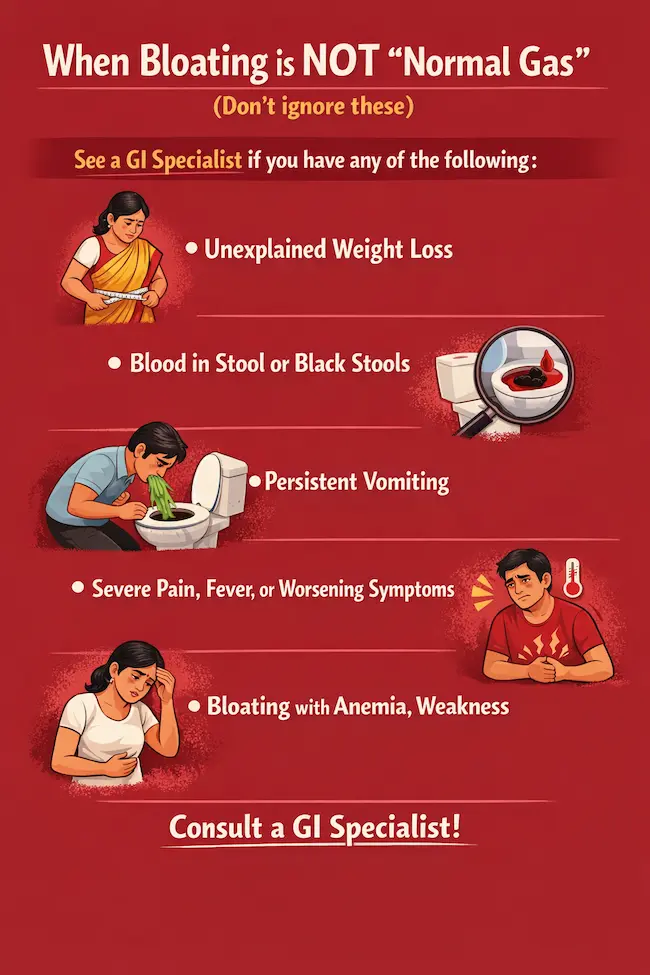
    When bloating is NOT “normal gas” (don’t ignore these)

    See a GI specialist if you have any of the following:

    ChatGPT Image Jan 16, 2026, 04 44 48 PM
    • Unexplained weight loss
    • Blood in stool or black stools
    • Persistent vomiting
    • Severe pain, fever, or worsening symptoms
    • Bloating with anemia, weakness
    • Symptoms waking you at night frequently
    • New symptoms after age 40–45 that persist
    • Family history of GI cancers or inflammatory bowel disease

    These don’t mean something serious is guaranteed—but they do mean you should not self-treat for months.


    What to do next (simple plan)

    Image

    If you suspect simple gas/indigestion:

    Try a 7-day reset: early dinner + low oil + slow eating + walking + reduce trigger veggies in large portions.

    If you suspect gastritis:

    Stop late-night tea/coffee + reduce spicy/oily food + avoid painkiller overuse + get evaluated if it keeps returning.

    If you suspect IBS:

    Track symptoms for 2 weeks (food + stress + stool pattern). IBS improves massively when treated with a structured plan—not random “gas tablets.”


    Consult support (PancreaCare by Advitya Healthcares)

    Untitled design (3)

    If bloating is recurring, affecting your routine, or you’re confused between gas vs gastritis vs IBS, it’s worth getting a proper evaluation rather than trial-and-error.

    PancreaCare by Advitya Healthcares offers GI-focused consultation and structured guidance for digestive symptoms. If you’re in Kolkata, you can consider planned consultation and follow-up guidance (including reports review) so you get clarity and a long-term plan.

  • GI Cancer in Kolkata: Early Signs, Smart Screening & Where to Start (Advitya Healthcares)

    GI Cancer in Kolkata: Early Signs, Smart Screening & Where to Start (Advitya Healthcares)

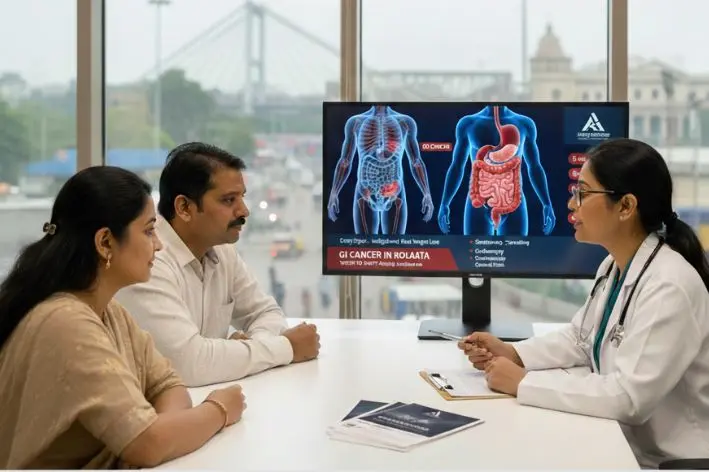
    In Kolkata, we often brush off gut symptoms as “gas,” “acidity,” or “something I ate.” A late dinner after work, weekend biryani, extra cha, street food cravings—most of us have been there. But when stomach or bowel symptoms persist, worsen, or come with warning signs, it’s important to think beyond routine indigestion. That’s where GI (gastrointestinal) cancers come into the conversation—not to create fear, but to encourage early action, because early detection can change outcomes dramatically.

    What is GI cancer?

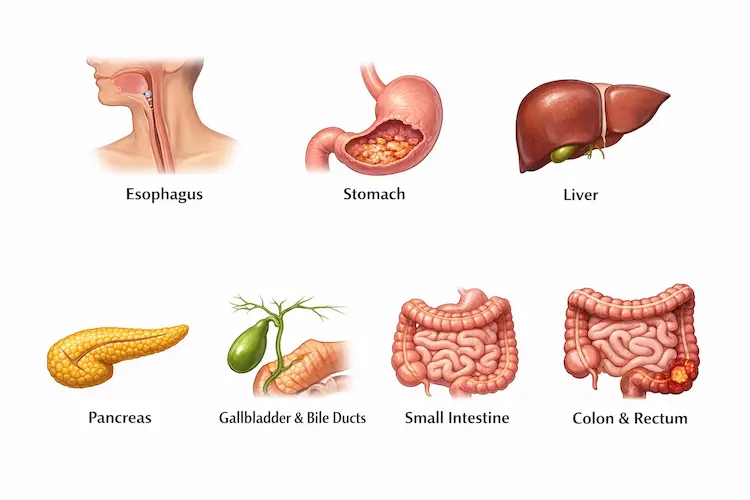
    “GI cancer” is an umbrella term for cancers that occur anywhere in the digestive system, including:

    • Esophagus (food pipe)
    • Stomach
    • Liver
    • Pancreas
    • Gallbladder and bile ducts
    • Small intestine
    • Colon and rectum (colorectal cancer)
    ChatGPT Image Jan 17, 2026, 02 01 33 PM

    Each has different patterns, risk factors, and treatments—but they often share one common truth: the earlier they’re found, the more treatable they tend to be.

    Why Kolkata families should pay attention

    Kolkata isn’t unique in having GI cancer risk—but some everyday exposures can increase the chances over time. Common contributors include:

    • Smoking and tobacco use (including smokeless forms)
    • Alcohol
    • Long-standing acidity/GERD (reflux symptoms that don’t improve)
    • Obesity, fatty liver, diabetes, and sedentary lifestyle
    • Chronic hepatitis B or C (raises liver cancer risk)
    • High intake of ultra-processed foods, excess oil, low fiber
    • Family history of GI cancers or polyps
    • Certain infections and long-term inflammation in the gut

    This doesn’t mean everyone with acidity or constipation has cancer—most don’t. But it does mean we should learn which symptoms deserve a proper evaluation instead of repeated self-medication.

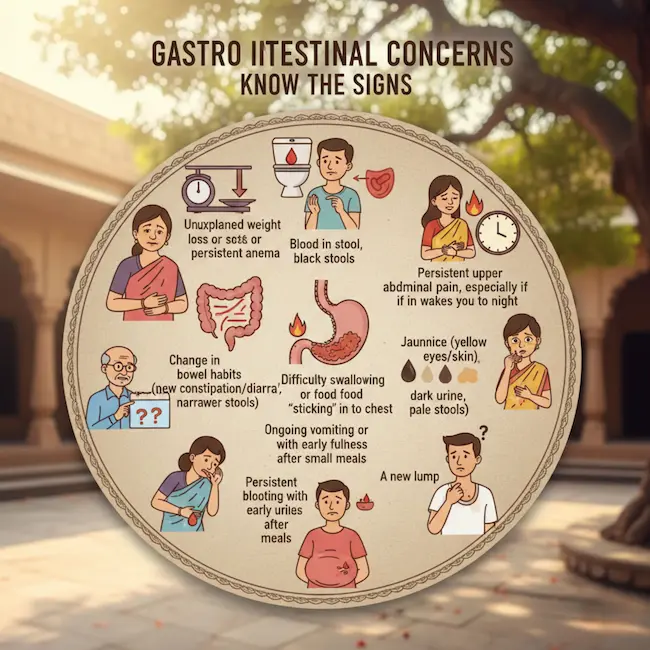
    Symptoms you should never ignore (the “red flag” checklist)

    If you notice any of the following, it’s wise to consult a GI specialist or GI cancer surgeon:

    • Unexplained weight loss or loss of appetite
    • Blood in stool, black stools, or persistent anemia
    • Change in bowel habits (new constipation/diarrhea, narrower stools) lasting weeks
    • Persistent upper abdominal pain, especially if it wakes you at night
    • Difficulty swallowing or food “sticking” in the chest
    • Ongoing vomiting or vomiting blood
    • Persistent bloating with early fullness after small meals
    • Jaundice (yellow eyes/skin), dark urine, pale stools
    • A new lump, fluid in the abdomen, or unexplained fatigue
    1768641314966

    Think of it like this: common symptoms become concerning when they are new, persistent, progressive, or paired with weakness/anemia/weight loss.

    Screening and early detection: the smartest step

    Many GI cancers start quietly. That’s why screening matters—especially for people with age-related risk, family history, or long-standing symptoms.

    Colorectal cancer screening is one of the most effective because many cancers develop from polyps over time. Screening can detect polyps early and remove them. Screening options may include stool-based tests or colonoscopy, depending on risk profile.

    For stomach and esophagus, an upper GI endoscopy helps when reflux is persistent, swallowing becomes difficult, or there’s ongoing pain, vomiting, or unexplained anemia.

    For liver cancer, people with chronic hepatitis or cirrhosis often need regular follow-up and monitoring as advised by their doctor.

    For pancreatic cancer, population-level screening is not routine; however, high-risk individuals (strong family history or certain genetic risks) may need specialized surveillance.

    If you’re unsure whether you need screening, a consultation can help you decide the safest, most practical plan—without unnecessary tests.

    How diagnosis usually happens (simple, step-by-step)

    At Advitya Healthcares, the evaluation typically follows a structured approach:

    1. Detailed history (symptoms timeline, diet, habits, family history)
    2. Clinical examination
    3. Basic blood work (including anemia and liver-related markers when needed)
    4. Imaging such as ultrasound/CT/MRI depending on symptoms
    5. Endoscopy/colonoscopy when indicated
    6. Biopsy to confirm diagnosis if a suspicious lesion is found
    7. Staging to understand how localized or advanced the disease is

    This step-wise approach avoids panic testing while still moving fast when red flags are present.

    Treatment options: not “one-size-fits-all”

    GI cancer treatment depends on the cancer type, stage, and the patient’s overall fitness. Common modalities include:

    • Surgery (often the main curative option for localized cancers)
    • Chemotherapy
    • Radiation therapy (in selected cancers)
    • Targeted therapy / immunotherapy (for specific cancer profiles)
    • Supportive care: nutrition, pain management, gut symptom control, recovery planning

    The goal is always to choose the most effective approach with the least avoidable burden, while preserving quality of life.

    Advitya Healthcares in Kolkata: where care feels structured and human

    When someone hears the word “cancer,” the first need is clarity: What is it? How serious? What do we do next? At Advitya Healthcares, patients in Kolkata benefit from a focused GI pathway that emphasizes:

    • Clear evaluation for suspicious GI symptoms
    • Guidance on the right investigations (not random test shopping)
    • Multidisciplinary planning (surgery + oncology coordination when required)
    • Support with nutrition and recovery planning
    • Focused expertise for complex GI and HPB (liver–pancreas–bile) conditions through PancreaCare by Advitya Healthcares

    Whether your concern is persistent reflux, bowel changes, jaundice, or unexplained weight loss—starting with the right specialist can save critical time.

    Prevention in daily Kolkata life (practical, doable)

    While not all GI cancers are preventable, risk can often be reduced:

    • Quit smoking/tobacco and avoid gutka/betel-nut habits
    • Keep alcohol limited or avoid it
    • Aim for more fiber: vegetables, fruits, whole grains, dal
    • Reduce ultra-processed foods and repeated deep-fried meals
    • Maintain healthy weight and regular walking
    • Manage diabetes and fatty liver early
    • Treat long-standing acidity/GERD instead of living on antacids
    • Take hepatitis vaccination advice seriously (when indicated)

    When should you book a consultation?

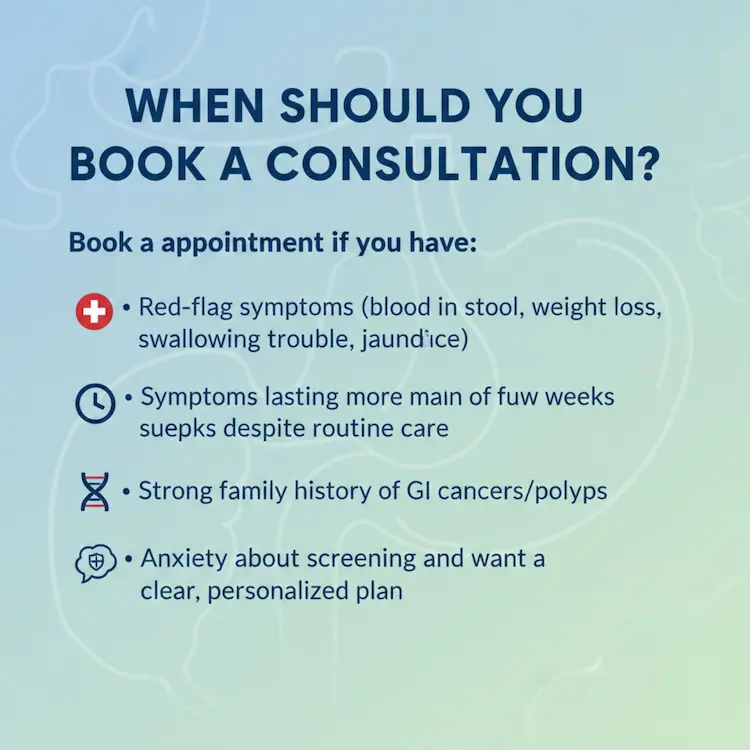
    Book an appointment if you have:

    • Red-flag symptoms (blood in stool, weight loss, anemia, swallowing trouble, jaundice)
    • Symptoms lasting more than a few weeks despite routine care
    • Strong family history of GI cancers/polyps
    • Anxiety about screening and want a clear, personalized plan
    1768643379815

    Final thought: In Kolkata, we’re experts at adjusting to discomfort—but GI cancer care rewards the opposite habit: act early, check properly, and move with clarity. If something feels “not normal for me,” that’s reason enough to get evaluated.

    Untitled design

    PancreaCare by Advitya Healthcares supports advanced care for liver–pancreas–bile and complex GI concerns.

    Book a consultation at Advitya Healthcares (Kolkata) for a structured GI evaluation and the right next steps.
    Disclaimer: This content is for awareness only and does not replace medical advice.


    FAQ section

    1. What is the most common early warning sign of GI cancer?
      There isn’t one single sign, but the most important are persistent symptoms—especially blood in stool, unexplained weight loss, anemia/weakness, swallowing difficulty, or jaundice.
    2. Can young adults get GI cancer?
      Yes—though risk increases with age, younger people can also develop GI cancers. In younger adults, red flags (blood in stool, weight loss, anemia) deserve attention, not assumptions.
    3. What does “GI cancer screening” mean?
      Screening means checking for cancer (or pre-cancer) before severe symptoms appear, using tests like stool tests, colonoscopy, and endoscopy, depending on risk and symptoms.
    4. How do I prepare for my first consultation?
      Carry your previous reports, list of medicines, symptom timeline (when it started, what worsens/relieves), family history, and any recent weight change details.
    5. What is PancreaCare by Advitya Healthcares?
      It’s the focused initiative under Advitya Healthcares for pancreas–bile–liver (HPB) and complex GI conditions, helping patients get structured evaluation and coordinated care.
  • Til–Gur, Pithe, Khichuri & Fried Snacks: Sankranti Eating Tips (Kolkata) Without Acidity or Gallbladder Pain

    Til–Gur, Pithe, Khichuri & Fried Snacks: Sankranti Eating Tips (Kolkata) Without Acidity or Gallbladder Pain

    In Kolkata, Makar Sankranti doesn’t feel like a “festival day” only—it feels like a winter emotion. The air is softer, rooftops have kites, the kitchen smells like nolen gur, and there’s always that one auntie saying, আরো একটু পিঠে খেয়ে নাও!” (have a little more pithe).

    But if you’ve ever had night acidity, burning chest, sour burps, or that sharp right-side upper belly pain after fried snacks—Sankranti can feel like a tug-of-war between joy and discomfort.

    This blog is for Kolkata families who want festival food with peace—not fear. You don’t need to “avoid everything.” You just need a smart plate, the right timing, and a little GI wisdom.


    Why Sankranti foods trigger acidity and gallbladder pain (simple Kolkata explanation)

    ChatGPT Image Jan 16, 2026, 02 11 51 PM

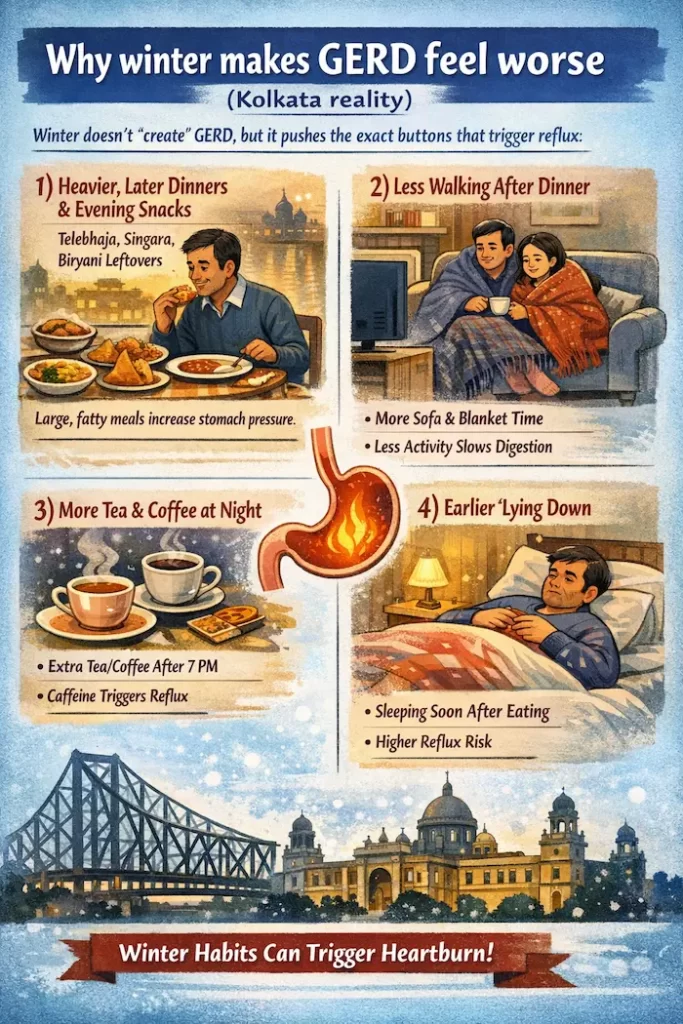
    1) Acidity (GERD) gets triggered by:

    • Deep-fried + spicy snacks (telebhaja, chops, singara)
    • Large meals (overfilling the stomach increases reflux)
    • Late eating + lying down early (winter blanket life!)
    • Extra tea/coffee after evening adda

    2) Gallbladder pain (especially gallstones) is often triggered by:

    • Fatty, fried foods (oil + ghee makes the gallbladder squeeze harder)
    • Heavy, greasy meals all at once
    • Sudden “festival binge” after light eating all day

    If you already have gallstones, the gallbladder can protest after a greasy meal with right upper abdominal pain, nausea, bloating, or pain that travels to the back/right shoulder.


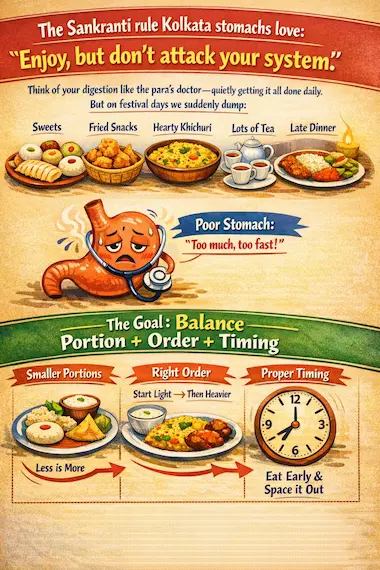
    The Sankranti rule Kolkata stomachs love: “Enjoy, but don’t attack your system”

    Think of your digestion like a quiet, hardworking para’s doctor—it manages everything daily. On festival days we suddenly dump:

    • sweets,
    • fried snacks,
    • heavy khichuri,
    • plus tea,
    • plus late dinner.

    So the goal is balance: portion + order + timing.


    Your Sankranti Eating Plan

    Before you start (the 10-minute protection ritual)

    Do this before pithe or fried snacks:

    • 1 glass warm water (not boiling)
    • If you tolerate it: a small banana or a small bowl of curd (plain)
    • Then eat festival items.

    This “base layer” helps reduce acid irritation and slows binge eating.


    1) Til–Gur (sesame + jaggery): how to eat without acidity spikes

    Til–gur is healthy—but for acidity-prone people, jaggery can feel “heavy,” and sesame can be dense.

    Best tips:

    • Eat small portion (2–3 small bites, not a big serving)
    • Prefer after lunch, not late evening
    • Avoid on an empty stomach if you have GERD
    • Don’t combine with tea/coffee immediately—keep a 45–60 min gap

    If you have gallstones: til–gur is usually okay in small amounts, but don’t combine it with fried snacks + heavy khichuri in the same sitting.


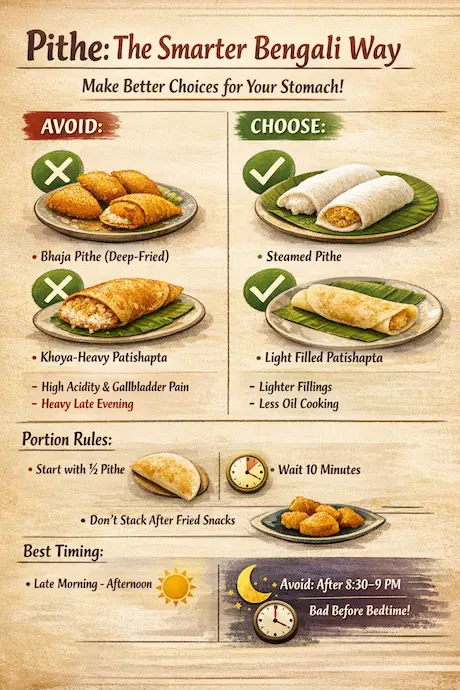
    2) Pithe (especially fried/khoya-heavy): the smarter Bengali way

    ChatGPT Image Jan 16, 2026, 02 09 57 PM

    Pithe is love. But certain types are tougher on the stomach:

    • Bhaja pithe / deep-fried pithe → high trigger for both acidity and gallbladder pain
    • Dudher pithe / patishapta with heavy filling → can be heavy late evening

    Choose better options (still tasty):

    • Prefer steam-based pithe or less-oil pan-cooked versions
    • Keep fillings lighter (less khoya, less coconut-ghee)

    Portion rules that work:

    • Start with ½ pithe, wait 10 minutes, then decide
    • Don’t stack pithe after a fried snack plate

    Timing tip:

    • Best window: late morning to afternoon
    • Worst window: after 8:30–9 pm, especially if you sleep by 11

    3) Khichuri (bhog-style): the “comfort food” that becomes heavy

    Kolkata winter + khichuri + begun bhaja = pure happiness. But a very oily, ghee-heavy khichuri can:

    • worsen reflux (heavy meal pressure)
    • trigger gallbladder contractions

    Eat khichuri like a GI-friendly Bengali:

    • Keep the plate: khichuri 60% + vegetables 40%
    • Choose one fried side, not many (e.g., only begun bhaja OR only papad)
    • Add a little plain curd if you tolerate dairy (cooling effect for reflux)

    If you have gallbladder stones:

    • Avoid ghee overload
    • Skip “double fried” combinations (khichuri + begun bhaja + aloor chop)

    4) Fried snacks (telebhaja, chops, singara): how to enjoy without pain

    Let’s be honest—Kolkata fried snacks are emotion. But for GERD and gallbladder issues, deep-fried foods are the most common triggers.

    Safe enjoyment rules:

    • Eat slowly (10–12 bites, not 2 minutes)
    • Choose one snack item, not a mixed plate
    • Avoid very spicy chutney if reflux is active
    • Don’t drink cold water immediately after (can worsen bloating)

    Best pairings:

    • Fried snack + warm water
    • Fried snack + small plain curd bowl (if suits you)

    Avoid:

    • Fried snack + tea + sweet = triple trigger combo

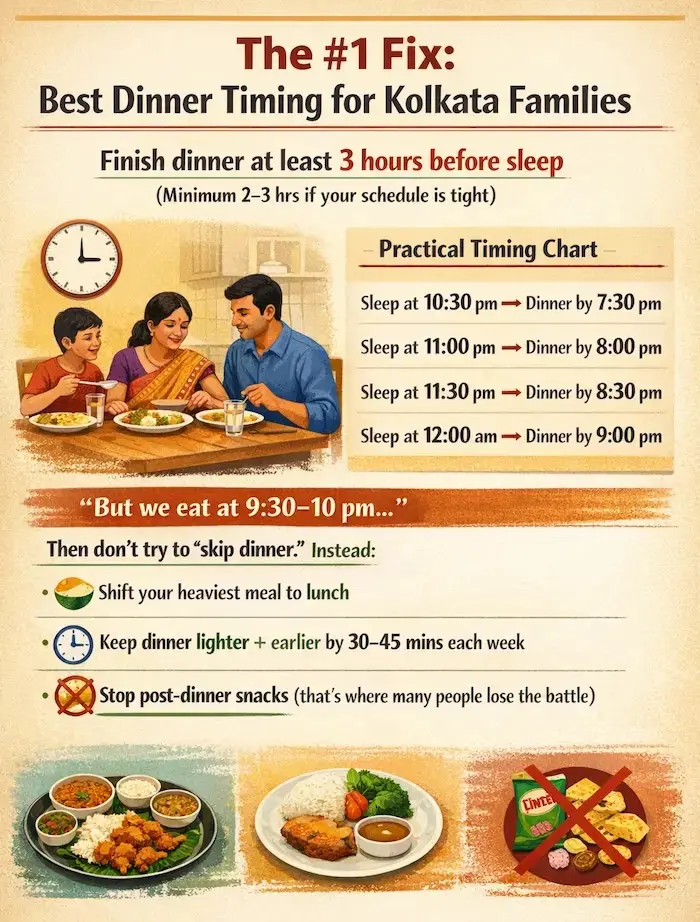
    The Kolkata Winter Timing Chart (this alone reduces acidity a lot)

    To prevent night acidity:

    • Finish your last heavy food at least 3 hours before sleep.

    Examples:

    • Sleep 10:30 pm → finish dinner by 7:30 pm
    • Sleep 11:00 pm → finish dinner by 8:00 pm
    • Sleep 11:30 pm → finish dinner by 8:30 pm

    If your Sankranti plan includes snacks at night, keep it light: warm water + a small portion, and avoid lying down right after.


    “Bengali Adda” habits that silently worsen acidity

    These are very Kolkata-specific:

    • Extra tea after 7 pm
    • Long sofa/blanket sitting right after dinner
    • Late-night “just one more” pithe

    GI-friendly swaps:

    • Replace late tea with warm water or light herbal tea (non-caffeinated)
    • Do a 10-minute slow walk after dinner (even inside the house)
    • Sit upright for 45–60 minutes after eating

    If you already have gallstones: a special Sankranti caution

    You don’t need panic. But if you have known gallstones or repeated gallbladder pain:

    • Keep meals small and low-fat
    • Avoid deep-fried + ghee-heavy foods on the same day
    • Don’t fast all day and then binge at night (big trigger)

    Red-flag symptoms (don’t ignore):

    • Strong right upper belly pain lasting > 1–2 hours
    • Fever, vomiting, yellow eyes/skin
    • Severe pain after oily food repeatedly

    These need medical evaluation—not home trials.


    Where GI healthcare comes

    A good GI system isn’t only for emergencies. Think of it like a “digestive safety net”:

    • If you get frequent acidity, you may need a GERD plan (diet + timing + proper meds when necessary)
    • If you get repeated right-side upper pain, you may need gallbladder evaluation (ultrasound is simple)
    • If you have bloating + gas + discomfort often, you may need targeted guidance (not random antacids)

    If you’re building a GI-focused healthcare journey in Kolkata, it helps to consult a GI–HPB team (gastro + hepatobiliary/surgery) so reflux, gallbladder, liver, and pancreas issues are handled in one connected approach—exactly how the body works.


    Sankranti doesn’t need to hurt

    Kolkata festivals are meant to feel like warmth—kites above, gur in the air, and family at the table. With a few smart tweaks, you can keep the emotion and lose the discomfort.

    Disclaimer: This blog is for awareness and food-timing guidance. If symptoms are frequent, severe, or worsening, please consult a qualified GI specialist.

  • Night Acidity in Winter: Why GERD Gets Worse + Best Dinner Timing for Kolkata Families

    Night Acidity in Winter: Why GERD Gets Worse + Best Dinner Timing for Kolkata Families


    What is night acidity (GERD) — in simple words?


    Why winter makes GERD feel worse (Kolkata reality)

    ChatGPT Image Jan 13, 2026, 06 53 46 PM

    The #1 fix: Best dinner timing for Kolkata families

    ChatGPT Image Jan 13, 2026, 06 46 24 PM (1)

    What your dinner should look like (GERD-safe Kolkata plate)


    Night posture tricks that actually work


    A 7-night “Winter GERD Reset” (simple home plan)


    When to stop self-treating and see a GI specialist (important)


    PancreaCare by Advitya Healthcares: how we can help

    At PancreaCare by Advitya Healthcares, we regularly see patients who think they have “simple acidity,” but actually have persistent GERD that needs a structured plan—sometimes lifestyle-focused, sometimes medicine-based, sometimes evaluation (like endoscopy) when symptoms are frequent or there are red flags.