Persistent Indigestion
Heartburn, burning or indigestion that keeps returning or does not settle with usual remedies.


Advitya Healthcares · Kolkata & Baruipur
KolkataBaruipur
Consultation venue and timings confirmed at the time of booking
WhatsApp UsAdvanced surgical care for stomach cancer with experienced specialists, modern surgical techniques and personalized treatment planning. Stomach cancer surgery at Advitya Healthcares is delivered within a gastrointestinal surgical practice experienced in complex abdominal and cancer surgery, with consultations available in Kolkata and Baruipur.
Your symptoms, endoscopy and biopsy findings, scans and previous reports are all reviewed before treatment is planned. Whether surgery is appropriate — and whether a partial or total gastrectomy, an open or a minimally invasive approach is suitable — is decided after staging and discussion with the multidisciplinary cancer team.
The surgical team is led by Dr. Deeksha Kapoor, a pancreato-biliary and gastrointestinal surgeon with training in advanced surgical oncology and minimally invasive surgery from institutions in India, Japan, Germany and France. She leads the PancreaCare+ programme at Advitya Healthcares.
Before surgery you are told what the operation involves, what anaesthesia is planned, how eating will change and what recovery looks like. After surgery you receive specific advice on diet, activity, supplements and follow-up. Vomiting blood, black stools, severe abdominal pain or an inability to swallow needs emergency assessment the same day.
Early symptoms are often mild and easy to mistake for ordinary indigestion. Symptoms that persist for more than a few weeks should be evaluated.
Heartburn, burning or indigestion that keeps returning or does not settle with usual remedies.
A vague ache, pressure or pain in the upper abdomen, often felt after eating.
Not feeling hungry, or losing interest in food, without an obvious reason.
Losing weight without changing your diet or activity levels.
Feeling sick, or vomiting, particularly after meals or on a regular basis.
Food feeling stuck, or discomfort when swallowing, especially with solid foods.
Feeling full or bloated after eating only a small amount of food.
Ongoing tiredness or weakness, which may be related to anaemia from slow blood loss.
Vomiting blood, or passing black, tarry stools, needs urgent medical evaluation.
Vomiting blood, black or tarry stools, severe abdominal pain, inability to swallow or keep fluids down, or sudden weakness require urgent medical assessment.
Call +91 92112 21551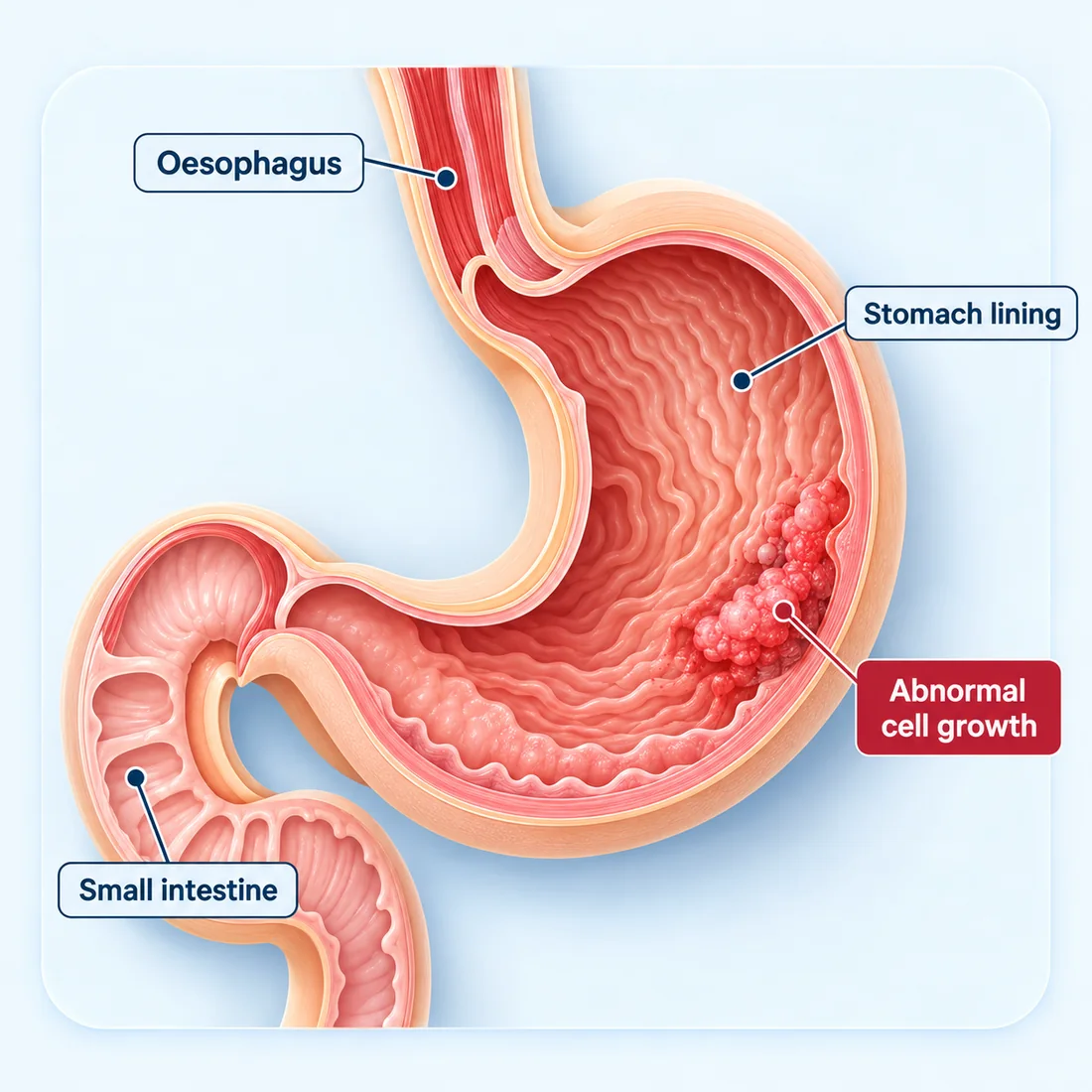
Stomach cancer, also called gastric cancer, develops when abnormal cells begin to grow in the lining of the stomach and form a tumour.
The stomach is lined by a layer of cells that produce acid and digestive juices. When some of these cells change and start to multiply in an uncontrolled way, they can form a growth in the stomach wall. Over time this growth may spread deeper into the wall, to nearby lymph nodes, or to other organs.
Stomach cancer can start in any part of the stomach — near the junction with the food pipe, in the main body of the stomach, or near the outlet into the small intestine. The location affects the symptoms and the type of surgery that may be needed.
Early stomach cancer frequently causes few or no symptoms, or symptoms that feel like ordinary indigestion. This is why persistent digestive symptoms, especially in adults over 40 or with risk factors, should be evaluated rather than ignored.
Whether surgery is required, and how much of the stomach needs to be removed, depends on the stage of the cancer, its location and your overall health. Endoscopy, biopsy and scans allow the team to plan treatment properly.
Diagnosis and treatment should be based on endoscopy, biopsy and staging investigations, reviewed by a specialist team.
Having a risk factor does not mean you will develop stomach cancer, and some people develop it without any known risk factor. These are the factors most often associated with the disease.
Long-standing infection with this stomach bacterium is one of the most important known risk factors.
A close relative with stomach cancer, or certain inherited conditions, increases risk.
Tobacco use raises the risk of cancer in the stomach, particularly near the food pipe.
Diets high in salted, smoked or preserved foods and low in fresh fruit and vegetables.
Long-term gastritis and changes in the stomach lining can increase the risk over time.
Earlier stomach surgery, stomach polyps or pernicious anaemia are associated with higher risk.
Stomach cancer becomes more common with age and is most often diagnosed in people over 50.
If several of these apply to you, or symptoms persist, an evaluation with a specialist is advised.
Diagnosis confirms whether cancer is present; staging shows how far it has spread. Both are needed before treatment can be planned.
Your symptoms, medical history, risk factors and previous reports are reviewed, and you are examined.
A thin flexible camera is passed through the mouth to examine the lining of the food pipe and stomach directly.
Small tissue samples taken during endoscopy are examined under a microscope to confirm the diagnosis and type of cancer.
A CT scan of the chest, abdomen and pelvis shows the extent of the tumour and whether nearby organs or lymph nodes are involved.
In selected cases a PET/CT scan may be used to look for spread that is not visible on other scans.
Blood tests check for anaemia, nutrition, organ function and general fitness for treatment.
Endoscopic ultrasound, diagnostic laparoscopy or other tests may be advised to complete staging before treatment.
Heart, lung and nutritional status are assessed so that treatment can be planned safely.
Results are discussed by surgeons, oncologists, radiologists and pathologists to agree a treatment plan.
The stage and type of stomach cancer can only be confirmed by endoscopy, biopsy and appropriate imaging.
Treatment depends on the cancer’s stage, its location in the stomach and your overall health. Most patients receive a combination of treatments planned by a multidisciplinary team.
Surgery to remove the tumour, part or all of the stomach and nearby lymph nodes is the main treatment for many stomach cancers that have not spread to distant organs.
Surgical optionsMedicines that destroy cancer cells. Chemotherapy is often given before surgery to shrink the tumour, after surgery to reduce the risk of recurrence, or as the main treatment when surgery is not suitable.
Discuss with our teamHigh-energy rays directed at the tumour. Used in selected situations, sometimes combined with chemotherapy, or to relieve symptoms such as bleeding or pain.
Discuss with our teamMedicines that act on specific features of cancer cells, such as the HER2 protein. Whether these are suitable depends on tests carried out on the biopsy tissue.
Discuss with our teamTreatments that help the body’s own immune system recognise and attack cancer cells. Offered to selected patients based on the stage of the cancer and test results.
Discuss with our teamSurgeons, medical and radiation oncologists, radiologists, pathologists and dietitians review each case together so that the sequence of treatments is planned for the individual patient.
Discuss with our teamNo single treatment is right for everyone. The recommended plan is decided after staging and multidisciplinary review.
The operation is chosen according to where the tumour is, how far it has spread and your general health. The digestive tract is reconnected so that you can continue to eat.
Removal of the affected portion of the stomach, most often the lower part, together with nearby lymph nodes. The remaining stomach is joined to the small intestine. Considered when the tumour is confined to one region of the stomach.
Discuss with our teamRemoval of the entire stomach when required, for example when the cancer is in the upper stomach or involves a large area. The food pipe is joined directly to the small intestine. Eating patterns change, and dietary support is part of recovery.
Discuss with our teamRemoval and examination of the lymph nodes around the stomach as part of the operation. This is an important part of cancer treatment and staging, helping to determine whether further treatment is needed after surgery.
Discuss with our teamThe type and extent of surgery can only be decided after endoscopy, biopsy, staging scans and multidisciplinary review.
Laparoscopic or robotic approaches may be appropriate for selected patients depending on the cancer and the clinical situation. Not every patient is eligible, and the choice of approach is a clinical decision.
The operation is carried out through several small incisions using a camera and long, fine instruments. The same cancer operation — removal of the tumour, part or all of the stomach and the lymph nodes — is performed, viewed on a screen.
A form of minimally invasive surgery in which the surgeon controls robotic instruments from a console. The instruments provide a magnified view and fine movement. It is used for selected patients where the facility and clinical situation allow.
The appropriate surgical approach is decided after staging and clinical evaluation, and may change during surgery if required for safety.
Specialist cancer surgery with a patient-first approach.
Stomach cancer surgery within a gastrointestinal surgical practice with training in surgical oncology.
Open and minimally invasive approaches considered according to clinical suitability.
Treatment is planned according to the stage, location of the cancer and the individual patient’s health.
Endoscopy, imaging and laboratory services used for diagnosis and staging.
Surgeons, oncologists and allied specialists review each case together to agree the treatment plan.
Dietary guidance, monitoring and continued care after treatment, in Kolkata and Baruipur.
Discuss symptoms, medical history and previous reports.
Appropriate investigations are performed to understand the disease.
A personalized treatment strategy is developed.
The appropriate treatment is provided based on the clinical plan.
Post-treatment monitoring and continued care.
Consultation, surgery and follow-up organised around the patient.
Stomach cancer care delivered by a specialist gastrointestinal surgical team.
Consultation, theatre, endoscopy and diagnostic facilities used for planned cancer care.
Time to discuss your reports, treatment options, what surgery involves and recovery.
Consultations available in Kolkata and Baruipur.
General information only. Advice for your own condition comes from your consultation.
Early symptoms are often vague and can resemble ordinary indigestion: persistent discomfort in the upper abdomen, feeling full after small meals, loss of appetite, nausea or unexplained weight loss. Symptoms that continue for more than a few weeks should be evaluated by a doctor.
An upper GI endoscopy allows the stomach lining to be examined directly and a biopsy to be taken. A biopsy confirms the diagnosis. CT scans, and in some cases PET/CT and other staging investigations, are then used to understand how far the cancer has spread.
Not always. Whether surgery is appropriate depends on the stage and location of the cancer and on your overall health. Some patients receive chemotherapy before surgery, some very early cancers may be treated endoscopically, and some patients are best treated without an operation. The plan is made after staging and discussion with the multidisciplinary team.
Gastrectomy is the surgical removal of part of the stomach (partial gastrectomy) or the whole stomach (total gastrectomy), usually together with nearby lymph nodes. The digestive tract is then reconnected so that food can continue to pass through.
Yes. After a total gastrectomy the small intestine is joined to the oesophagus. Patients eat smaller, more frequent meals, and need long-term vitamin B12 supplementation. Dietary guidance is part of recovery and follow-up.
Laparoscopic or robotic-assisted approaches may be appropriate for selected patients, depending on the stage and location of the cancer, previous abdominal surgery and fitness for anaesthesia. Not every patient is suitable, and the approach is decided after clinical evaluation.
Many patients with stomach cancer receive chemotherapy before and/or after surgery, and some may be offered targeted therapy, immunotherapy or radiation therapy. Whether these are recommended depends on the stage of the cancer and is decided by the multidisciplinary cancer team.
Recovery varies with the type of operation, the approach used and your general health. A hospital stay of several days is usual, and eating is reintroduced gradually. Your surgical team will give specific advice about diet, activity and follow-up before discharge.
Vomiting blood, black or tarry stools, severe abdominal pain, inability to swallow or keep fluids down, or sudden weakness require urgent medical assessment. Go to your nearest emergency department the same day.
Consult our experienced surgical team for evaluation, diagnosis and personalized treatment planning.
Stomach Cancer Surgery — our team will call you back to confirm the venue, date and time.