

PancreaCare by
Advitya Healthcares
___________________________________________
National Cancer Prevention Month
Written for patients and their families — plain language, real answers.
___________________________________________
Covering: Oesophageal | Stomach | Liver | Gallbladder | Bile Duct
Pancreatic | Small Bowel | Colon | Rectal | Anal | GIST | NETs
| IMPORTANT NOTICE This blog is for general health education only. It is not a substitute for professional medical advice, diagnosis, or treatment. Always speak with your own doctor or specialist about your personal health situation. |
Warning Signs: When to See a Doctor
No matter which GI cancer we’re talking about, certain symptoms should always prompt a visit to your doctor without delay. They don’t automatically mean cancer — but they always deserve investigation:
| Red Flag Symptoms — Never Ignore These Unexplained weight loss or loss of appetite Difficulty swallowing or pain when swallowing Persistent indigestion, heartburn, or abdominal pain Vomiting blood, or vomit that looks like coffee grounds Black, tarry, or bloody stools New jaundice — yellowing of skin or whites of the eyes Dark urine and pale/clay-coloured stools A change in bowel habits lasting more than 3 weeks Unexplained new anaemia (low blood count) New-onset diabetes after age 50, especially with weight loss A lump or swelling in the abdomen If you have any of these — please make an appointment with your GP today. Early detection genuinely saves lives. |
| About This Guide This guide is brought to you by PancreaCare by Advitya Healthcares.This is one section from a 12-part GI cancer series, and each section follows the same structure—what it is, why it happens, how to lower your risk, how it’s diagnosed, how it’s treated (including what surgery involves), and what recovery looks like—so you can use the headings to jump to what you need, or read straight through, because knowledge is the best first step. |
Gallbladder Cancer
What Is It?
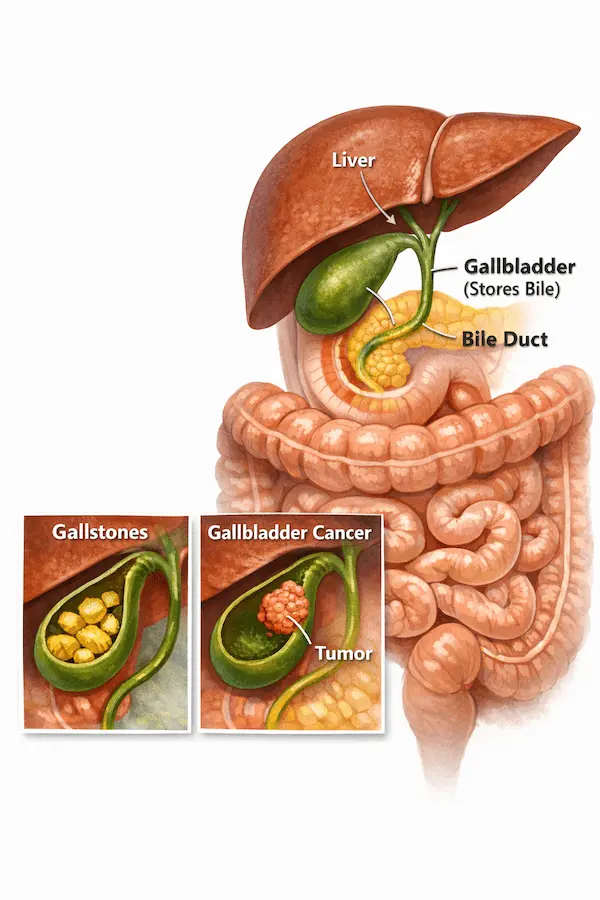
The gallbladder is a small pear-shaped pouch tucked beneath the liver. Its job is to store bile — a digestive fluid made by the liver — and release it into the small intestine after meals to help digest fats.
Gallbladder cancer is not common, but it’s important to know about because it’s often linked to gallstones, which are very common. It tends to be found at a later stage because it rarely causes distinct symptoms early on.
Why Does It Happen? (Causes & Risk Factors)
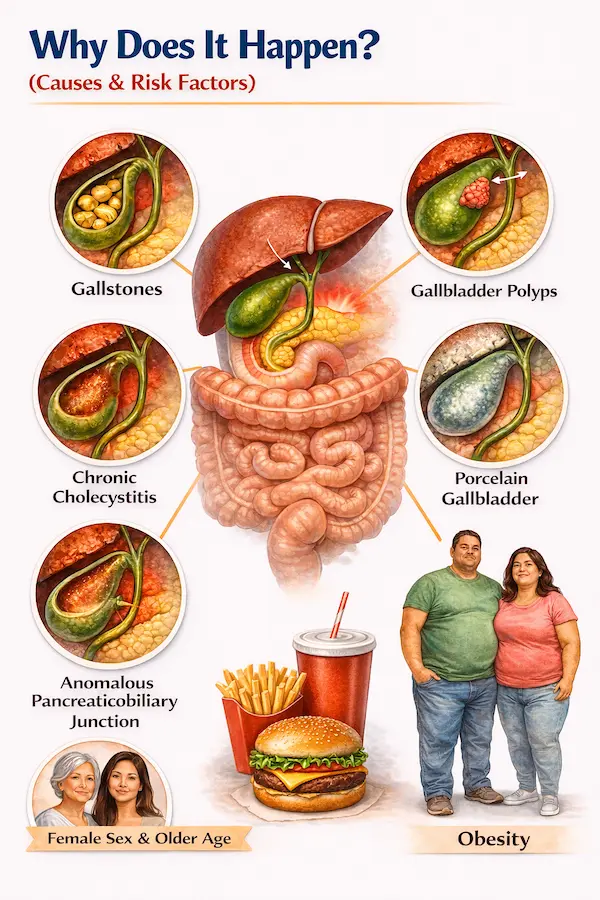
The common thread in gallbladder cancer is chronic inflammation and irritation of the gallbladder wall:
- Gallstones (cholelithiasis) — especially large stones causing repeated episodes of inflammation
- Chronic cholecystitis (long-standing gallbladder inflammation)
- Gallbladder polyps — particularly those larger than 1 cm
- Porcelain gallbladder (calcification of the gallbladder wall from chronic inflammation)
- Anomalous pancreaticobiliary junction (a structural abnormality where bile duct joins the pancreatic duct abnormally)
- Female sex and older age
- Obesity and certain ethnic backgrounds (higher rates in some South American and South Asian populations)
How Can I Lower My Risk?
How Is It Diagnosed?
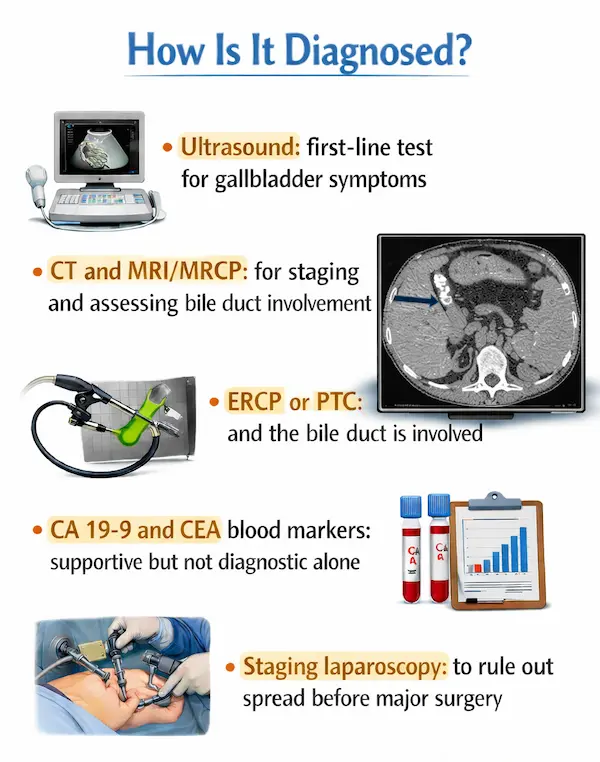
Gallbladder cancer is often suspected on imaging done for other reasons, or when gallbladder removal (cholecystectomy) reveals unexpected cancer:
How Is It Treated?
Surgery offers the only chance of cure; the extent depends on how far the cancer has spread:
- Simple cholecystectomy: removal of the gallbladder alone — sufficient for very early incidental cancers
- Extended cholecystectomy: removal of the gallbladder plus a margin of liver and nearby lymph nodes — for most operable cancers
- Bile duct resection: if the bile duct is involved
- Chemotherapy (gemcitabine + cisplatin or capecitabine) after surgery or for advanced disease
- Stent placement: to relieve jaundice caused by bile duct blockage in advanced cases
| The Surgery: Extended Cholecystectomy For most operable gallbladder cancers, surgery involves removing the gallbladder, a wedge of liver tissue immediately adjacent to it, and lymph nodes in the nearby region. If the bile duct is involved, that section of bile duct is also removed and the bowel is reconnected (biliary reconstruction). The goal is complete removal of all cancer with clear margins. Hospital stay is typically 5-10 days depending on complexity. |
Aftercare & Recovery
Leave a Reply
You must be logged in to post a comment.