Unexplained Weight Loss
Losing weight without trying, over weeks or months, can be an early sign that should be checked.


Advitya Healthcares · Kolkata & Baruipur
KolkataBaruipur
Consultation venue and timings confirmed at the time of booking
WhatsApp UsLiver cancer and HPB (hepato-pancreato-biliary) surgery at Advitya Healthcares is delivered within a gastrointestinal and surgical oncology practice experienced in complex liver, bile duct, gallbladder and pancreatic disease. The team evaluates and treats hepatocellular carcinoma, intrahepatic cholangiocarcinoma, secondary (metastatic) liver tumours and other complex liver tumours, with consultations available in Kolkata and Baruipur.
Your scans, blood tests, liver function, previous treatment and overall health are all considered before a plan is made. Whether a tumour is best treated by liver resection, ablation, transplant evaluation, chemotherapy, targeted therapy or immunotherapy — or a combination — is decided through multidisciplinary review, and an open or minimally invasive approach is chosen according to clinical suitability.
The surgical team is led by Dr. Deeksha Kapoor, a surgical gastroenterologist and HPB & GI surgical oncologist. She trained in surgical gastroenterology at Medanta – The Medicity, completed an HPB & GI Surgical Oncology Fellowship at Tata Memorial Hospital, Mumbai, is console-trained in robotic surgery on the Da Vinci Xi platform, and has pursued advanced HPB training in Japan, Germany and France. She leads the PancreaCare initiative at Advitya Healthcares.
Before surgery you are told what the operation involves, how much liver will be removed, what anaesthesia is planned and what recovery looks like. After surgery you receive specific advice on diet, activity, wound care, follow-up scans and any further treatment. Sudden severe abdominal pain, rapidly increasing jaundice, vomiting blood, high fever or confusion need emergency assessment the same day.
Early liver cancer often causes no symptoms. Recognising these signs can help you seek timely medical evaluation.
Losing weight without trying, over weeks or months, can be an early sign that should be checked.
Feeling full after small meals, reduced appetite, nausea or vomiting that does not settle.
Pain, heaviness or fullness in the upper right abdomen, sometimes felt in the right shoulder or back.
Yellowing of the skin and eyes, dark urine, pale stools or itching caused by a build-up of bile.
A swollen abdomen from fluid build-up (ascites) or an enlarged liver that can be felt under the ribs.
Persistent tiredness or weakness, and fever without an obvious cause, should be evaluated.
Sudden severe abdominal pain, rapidly increasing jaundice, vomiting blood or black stools, high fever with shivering, confusion or drowsiness require urgent medical assessment.
Call +91 92112 21551Liver cancer is named after the cell it starts from, or the organ it has spread from. The type influences how it is assessed and treated.
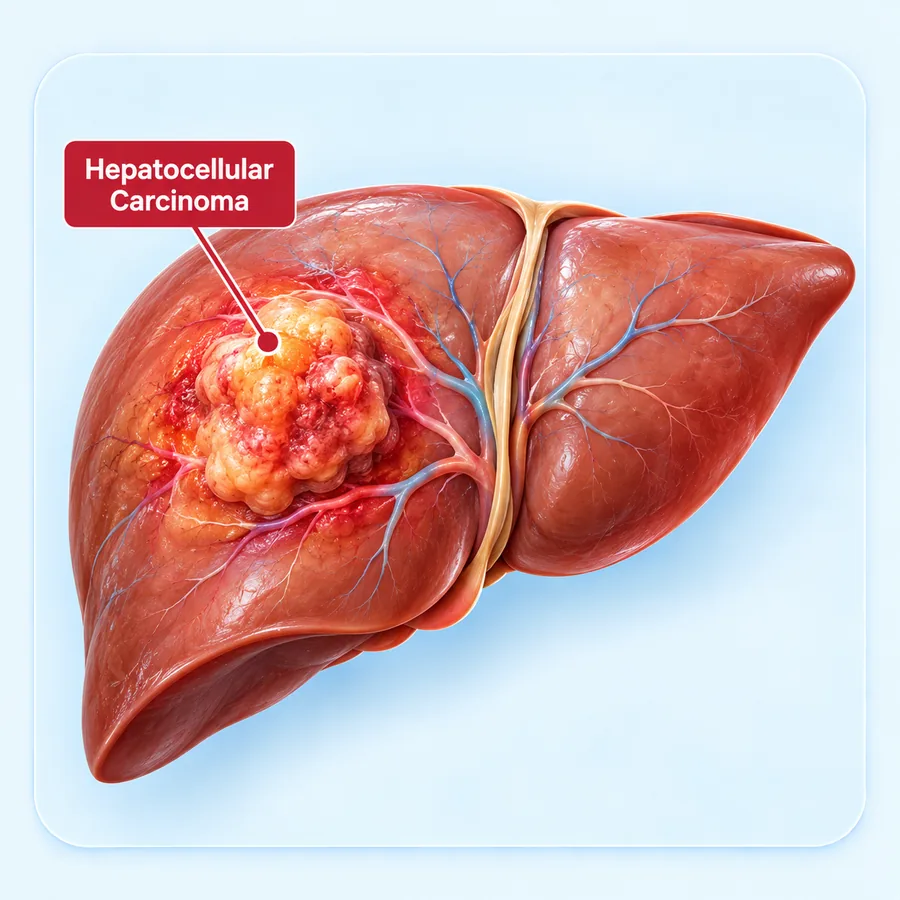
The most common primary liver cancer. It starts in the liver cells themselves and often develops in a liver already affected by cirrhosis, hepatitis B or C, or fatty liver disease.
Discuss with our team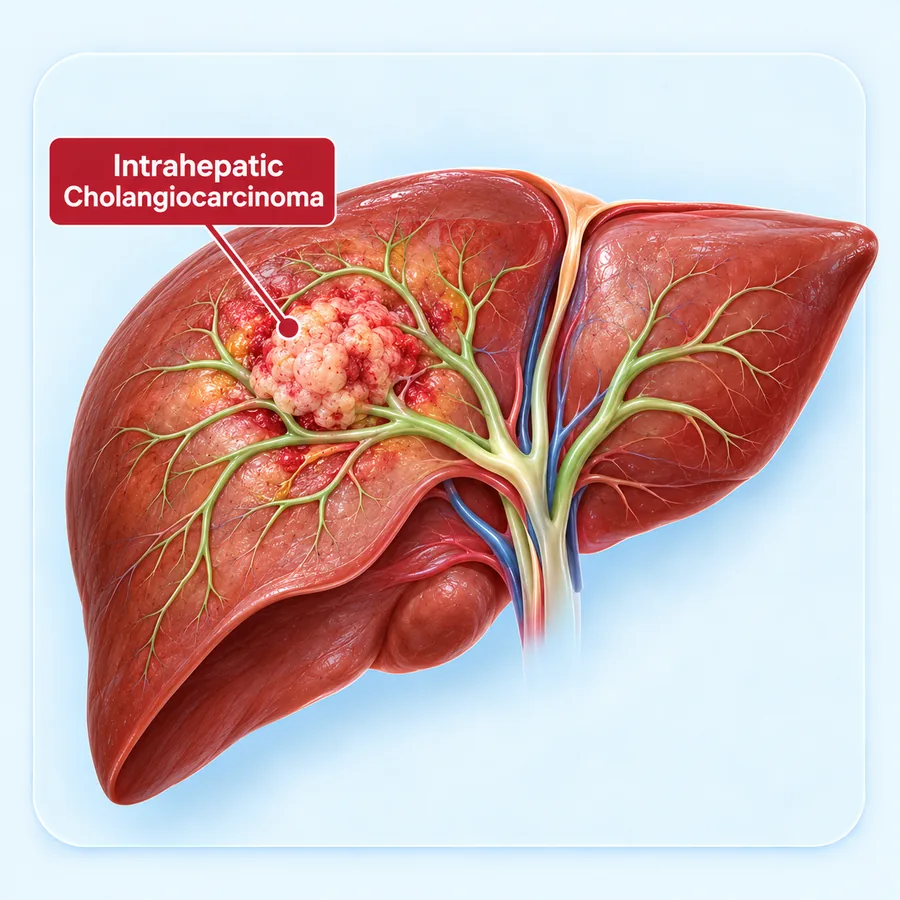
A cancer that starts in the small bile ducts within the liver. It is less common than hepatocellular carcinoma and is assessed and treated differently.
Discuss with our team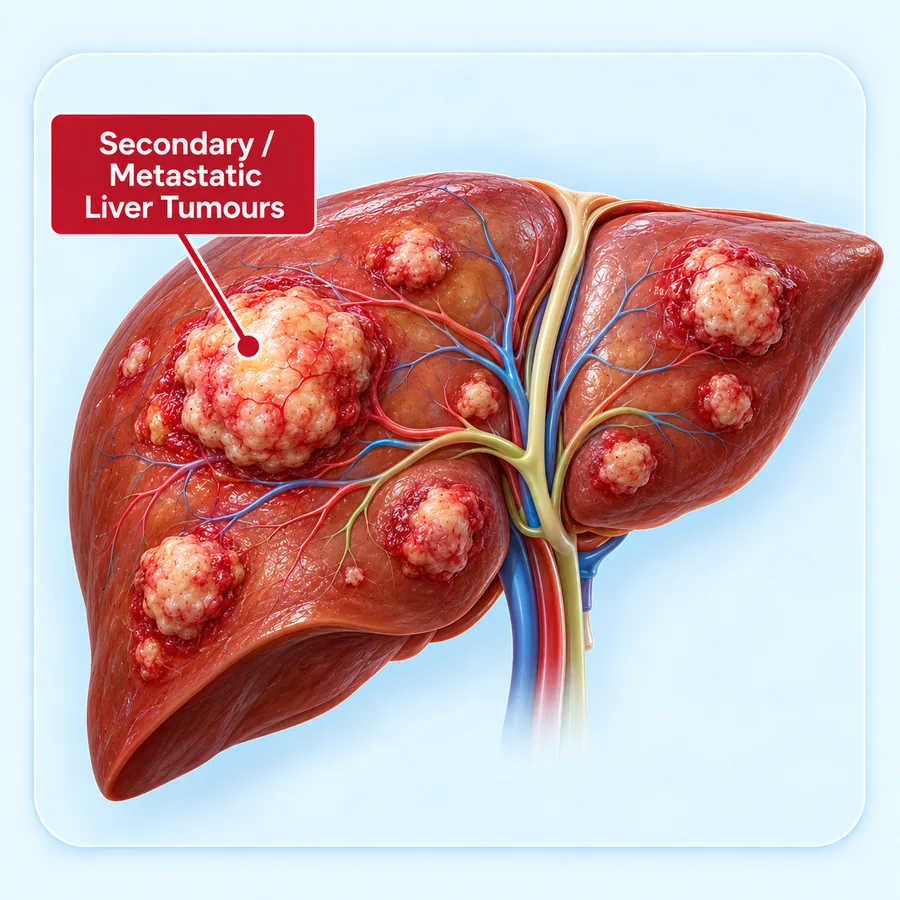
Cancer that has spread to the liver from another organ, most often the bowel (colorectal liver metastases). Selected patients benefit from liver surgery as part of their cancer treatment.
Discuss with our teamThe type, size and stage of a liver tumour can only be confirmed by imaging, blood tests and, where required, biopsy.
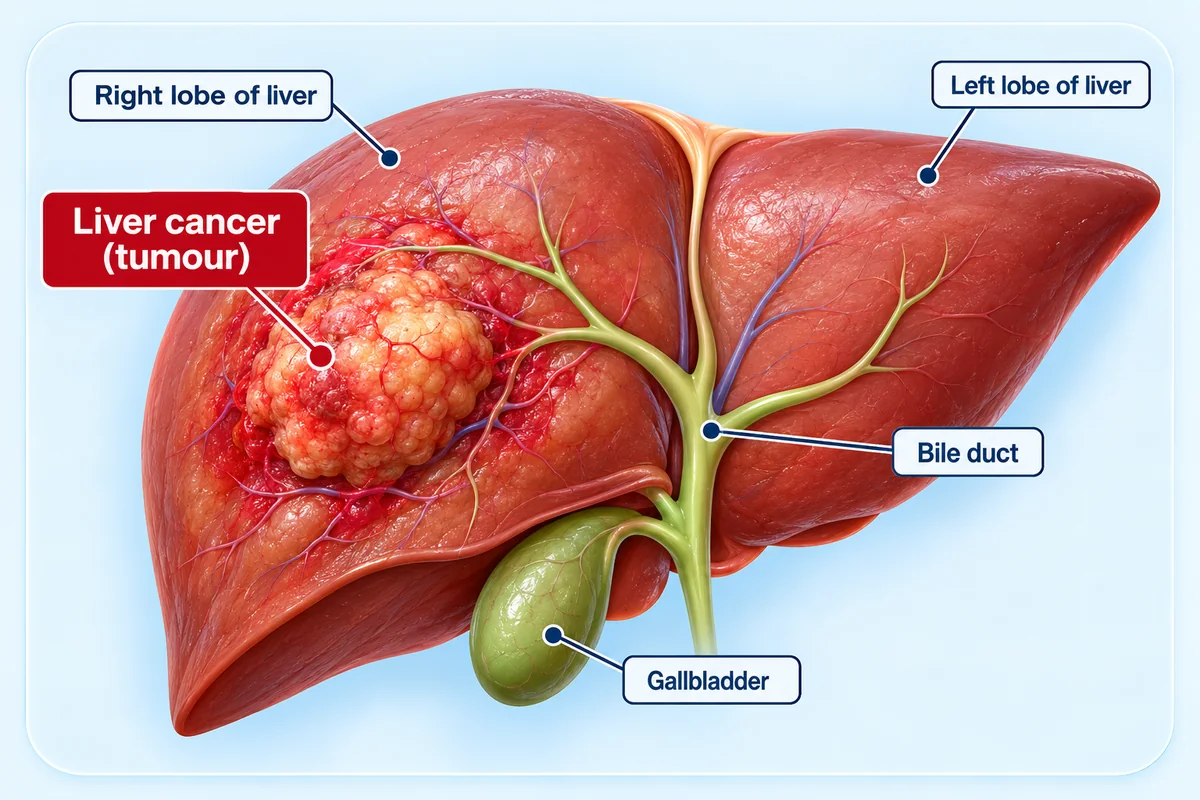
Liver cancer is a growth of abnormal cells in the liver. It may start in the liver itself (primary liver cancer) or spread to the liver from another organ (secondary or metastatic liver cancer).
The liver filters blood, processes nutrients and produces bile. Long-term damage from hepatitis B or C, alcohol, fatty liver disease or cirrhosis can cause liver cells to change and grow abnormally. Cancers of other organs, especially the bowel, can also spread to the liver through the bloodstream.
A tumour can develop in either lobe of the liver, close to the major blood vessels, or in the bile ducts that run through the liver. Its exact position and relationship to these vessels is what determines whether it can be removed safely.
The liver has a large reserve, so small tumours rarely cause symptoms. Pain, jaundice, swelling and weight loss usually appear only when a tumour is larger or the liver is not working well — which is why people at risk are advised to have regular surveillance scans.
The type, size, number and position of tumours, and how well the rest of the liver works, guide whether surgery, ablation, transplantation or medical therapy is appropriate. Careful staging avoids both under-treatment and unnecessary surgery.
Diagnosis and treatment should be based on imaging, blood tests and multidisciplinary review of your individual case.
Treatment is matched to the type and stage of the cancer, liver function and your overall health.
Surgical removal of the part of the liver containing the tumour, preserving enough healthy liver for normal function.
Heat-based treatment (radiofrequency or microwave) that destroys small tumours through a needle, guided by imaging.
Assessment of whether a transplant is the right option for selected patients, particularly with cirrhosis, and guidance to the appropriate pathway.
Medicines given before or after surgery, or as the main treatment, depending on the type and stage of the cancer.
Newer medicines that block cancer growth signals or help the immune system recognise and attack cancer cells.
Surgeons, medical oncologists, radiologists and hepatologists review each case together to plan the right combination of treatments.
Liver resection removes the cancerous portion of the liver while preserving healthy liver tissue whenever appropriate. The remaining liver can regenerate over the following weeks. Which approach suits you is a clinical decision.
The surgeon works through an incision under the right ribs. The tumour is removed together with a margin of healthy tissue, and the blood vessels and bile ducts supplying that segment are carefully controlled. Anything from a small wedge to a full lobe (hemi-hepatectomy) may be removed, depending on the tumour.
The resection is carried out through several small incisions using a camera and specialised instruments, either laparoscopically or with robotic assistance. Suitability depends on the size, number and position of the tumours, previous surgery and your fitness for anaesthesia.
The appropriate surgical approach is decided after imaging, liver function assessment and multidisciplinary review.
Liver cancer surgery sits inside a wider hepato-pancreato-biliary practice — surgery of the liver, bile ducts, gallbladder and pancreas. That work has a page of its own.
HPB surgery: liver surgery, bile duct surgery, gallbladder and bile duct cancer surgery, pancreatic surgery and complex hepatobiliary procedures — see the HPB Surgery page.
Specialist care with a patient-first approach.
Liver cancer and HPB surgery led by a surgeon trained in surgical gastroenterology and HPB & GI surgical oncology at high-volume centres.
Open, laparoscopic and robotic-assisted liver and HPB procedures considered according to clinical suitability.
Access to CT, MRI, blood tests and biopsy for accurate staging and liver function assessment before treatment.
Treatment is planned according to the type and stage of the tumour, liver function and your individual clinical situation.
Surgeons, medical oncologists, radiologists and hepatologists review each case together to agree the right plan.
Clear communication before surgery, during recovery and throughout follow-up, in Kolkata and Baruipur.
Initial evaluation and medical history.
Imaging, blood tests and other investigations.
A personalized treatment plan is created.
Appropriate surgical or non-surgical treatment.
Post-treatment monitoring and continued care.
Consultation, treatment and follow-up organised around the patient.
Liver cancer and HPB care delivered by a specialist surgical oncology team.
Consultation, theatre, imaging and diagnostic facilities used for planned cancer surgery.
Time to discuss your scans, reports, treatment options and recovery.
Consultations available in Kolkata and Baruipur.
General information only. Advice for your own condition comes from your consultation.
Early liver cancer often causes no symptoms. When symptoms appear they may include unexplained weight loss, loss of appetite, pain or fullness in the upper right abdomen, yellowing of the skin and eyes (jaundice), abdominal swelling, tiredness, nausea and unexplained fever. Many people with cirrhosis or hepatitis B or C are diagnosed through regular surveillance scans before any symptoms occur.
No. Treatment depends on the type, size, number and position of the tumours, how well the rest of the liver is working, and your general health. Some tumours are best treated with resection, others with ablation, transplantation, chemotherapy, targeted therapy or immunotherapy, or a combination. The plan is decided after multidisciplinary review of your scans and reports.
Liver resection is an operation that removes the part of the liver containing the tumour together with a margin of healthy tissue, while preserving enough healthy liver for the body to function. The remaining liver can regenerate over the following weeks. Suitability depends on tumour position and the health of the remaining liver.
Minimally invasive (laparoscopic or robotic) liver resection is possible for selected tumours, using small incisions, a camera and specialised instruments. It is not appropriate for every tumour or every patient; suitability is assessed after reviewing your imaging and fitness for anaesthesia.
HPB stands for Hepato-Pancreato-Biliary. HPB surgery covers operations on the liver, the bile ducts, the gallbladder and the pancreas, including surgery for gallbladder cancer, bile duct cancer (cholangiocarcinoma) and pancreatic tumours.
Some patients need chemotherapy, targeted therapy or immunotherapy before or after surgery, and some are treated without surgery at all. This depends on the type and stage of the cancer and is decided through multidisciplinary discussion between surgeons, medical oncologists, radiologists and other specialists.
For certain patients, particularly those with liver cancer arising in a cirrhotic liver, transplantation may be considered. Evaluation looks at tumour size and number, liver function, general fitness and donor options. If transplantation is appropriate, you are guided to the right pathway and supported through the process.
Recovery varies with the extent of the operation, the approach used and your general health. Most patients stay in hospital for several days after a major liver resection and continue recovering at home for a few weeks. Your surgical team gives specific advice about diet, activity, wound care and follow-up before discharge.
Sudden severe abdominal pain, rapidly increasing jaundice, vomiting blood or passing black stools, high fever with shivering, confusion or drowsiness, or rapid abdominal swelling require urgent medical assessment. Go to your nearest emergency department the same day.
Consult our experienced surgical team for evaluation and personalized treatment planning.
Six fields, nothing clinical. We will call you back to confirm.