Gastro-Oesophageal Reflux
Acid escaping upward through an incompetent lower sphincter. Common, and controlled by lifestyle and medication in most patients — but reflux persisting for years is a reason for at least one endoscopy.
Common
Precise diagnosis and lasting treatment for reflux disease, achalasia, hiatal hernia and swallowing disorders — because difficulty swallowing is never normal.
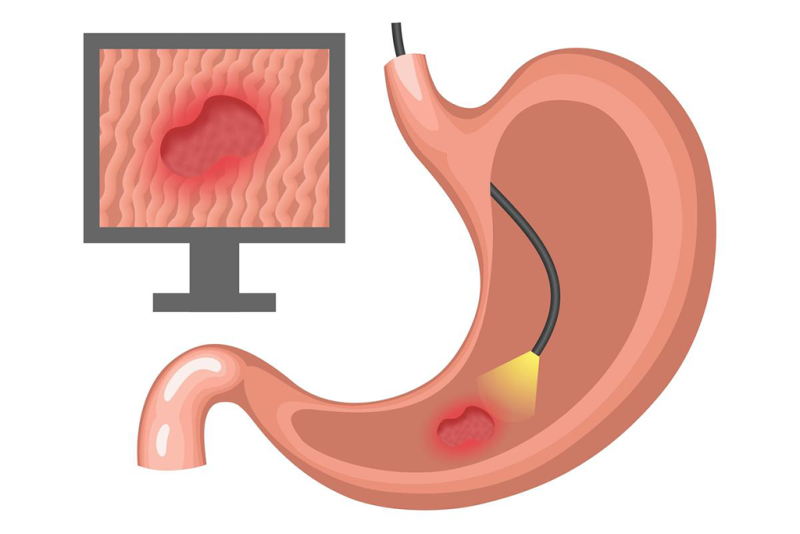
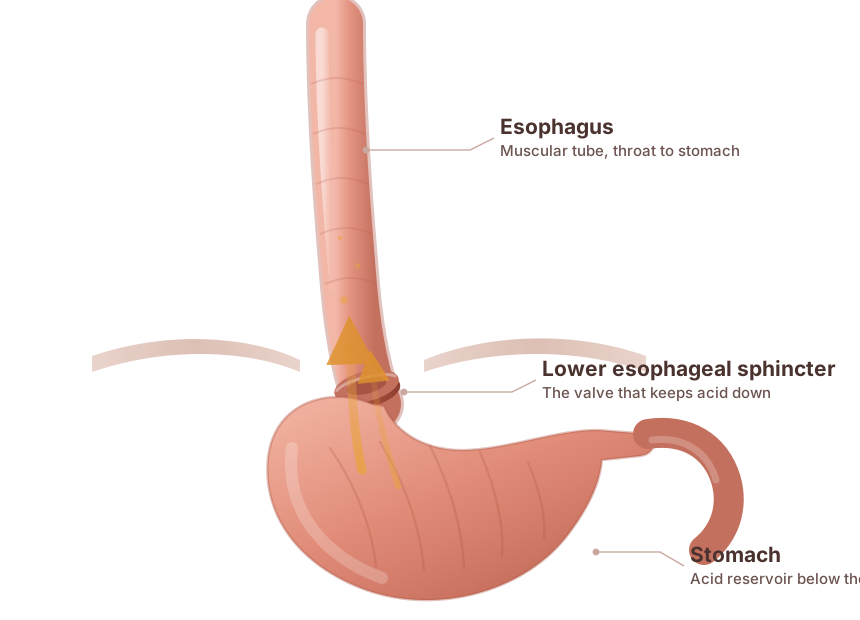
The oesophagus carries food from throat to stomach by coordinated waves of muscular contraction. A valve at its lower end opens to let food through and closes to keep acid out. Almost every oesophageal condition is a failure of one of those two things — the muscle, or the valve.
When the valve fails, acid refluxes upward and causes heartburn. Sustained over years, that exposure can transform the lining of the lower oesophagus into an intestinal-type epithelium — Barrett's oesophagus. Barrett's is not cancer, and most people who have it never develop cancer, but it is the recognised precursor to adenocarcinoma, which is why it is kept under surveillance rather than simply treated.
When the muscle fails, swallowing itself becomes difficult. Achalasia — where the lower valve never relaxes — produces a slow obstruction that patients adapt to for years before seeking help. Any difficulty swallowing that is worsening, particularly progressing from solids to liquids, needs an endoscopy promptly rather than eventually.
From reflux controlled by lifestyle to a full oesophagectomy — each condition is managed by the same specialist team, using one shared treatment plan.
Acid escaping upward through an incompetent lower sphincter. Common, and controlled by lifestyle and medication in most patients — but reflux persisting for years is a reason for at least one endoscopy.
CommonMetaplastic change in the lower oesophageal lining after years of acid exposure. Not cancer, and usually never becomes cancer — but it is the recognised precursor, so it is monitored by periodic endoscopy.
SurveillanceDegeneration of the nerve plexus in the oesophageal wall, so peristalsis fails and the lower sphincter never relaxes. Produces slow, progressive obstruction that patients often tolerate for years before diagnosis.
MotilityPart of the stomach sliding through the diaphragm into the chest, disrupting the anatomy that normally keeps the valve competent. The commonest structural reason reflux does not settle on medication alone.
StructuralFibrotic narrowing after years of acid injury, causing food to stick. Treated by endoscopic dilation alongside acid control, since dilation without controlling the cause simply buys time.
EndoscopicOutpouchings of the wall, including Zenker's diverticulum at the top. Cause regurgitation of undigested food, halitosis and, in some patients, aspiration at night.
SurgicalSquamous cell carcinoma in the upper and middle oesophagus, adenocarcinoma at the lower end and junction. Progressive dysphagia — solids first, then liquids — is the presentation that matters most.
Surgical oncologyHeartburn is common and often harmless. Difficulty swallowing is neither — it always warrants investigation, whatever else is going on.
Food sticking, progressing from solids to liquids over months. Never normal.
Burning behind the breastbone, worse lying flat or after a large late meal.
Undigested food or sour fluid returning to the mouth, sometimes staining the pillow.
Reflux reaching the larynx, often mistaken for a respiratory or throat problem.
Squeezing central pain from oesophageal spasm — cardiac causes excluded first.
Losing weight because swallowing has become difficult. A red flag combination.
Symptoms alone cannot separate reflux from a motility disorder from a tumour. Each test below answers a question the previous one could not.
History, examination and a review of every previous report, scan and prescription.
Direct view of the lining to find oesophagitis, stricture, hernia or Barrett's change.
A dynamic study showing how a bolus actually travels — useful for strictures and hernias.
Measures muscular coordination and quantifies real acid exposure over a full day.
Where a tumour is found, depth of invasion and spread determine what treatment is possible.
A written plan covering procedure, diet, recovery and follow-up schedule.
Lifestyle, medical, endoscopic and surgical care — chosen by what is actually failing, rather than by what is easiest to prescribe.
Weight reduction, smaller earlier meals, head-of-bed elevation and trigger avoidance, which control symptoms in a substantial share of patients.
Proton pump inhibitors to heal oesophagitis and control symptoms, reviewed periodically rather than continued indefinitely without reassessment.
Balloon or bougie dilation for peptic strictures and pneumatic dilation for achalasia, both performed without any incision.
Targeted ablation of dysplastic Barrett's segments through the endoscope, removing the precursor before it progresses.
Keyhole reconstruction of the valve for reflux that medication cannot hold, with hiatal hernia repair in the same operation.
Division of the lower sphincter muscle for achalasia, with a partial wrap to prevent the reflux that would otherwise follow. The most durable option.
Removal of the affected oesophagus with nodal clearance and reconstruction using the stomach, typically after neoadjuvant chemoradiation.
Prehabilitation before major surgery and a structured graded diet afterwards, with supplementation where swallowing remains limited.
Foregut surgery rewards experience more than almost any other GI field. Ours is done as core practice, close to where patients live.
Fellowship-trained gastrointestinal and surgical oncology, with fundoplication and myotomy as routine rather than occasional work.
Surgeons, gastroenterologists, radiologists, oncologists and dietitians working from one shared plan.
High-resolution manometry and 24-hour pH monitoring — so surgery is offered on measured evidence, not on symptoms alone.
A written plan for your stage, your fitness and your circumstances — with a cost estimate before admission.
A structured recall programme with defined intervals, so precursor change is caught while it is still endoscopically treatable.
Six stages, from your first appointment to long-term follow-up — so you always know where you are and what comes next.
Your history and existing reports reviewed by a specialist, in person or by video.
Direct examination with biopsy, under sedation, usually as a day case.
Manometry and pH study where the diagnosis is reflux or a motility disorder.
Medical therapy, dilation, ablation or surgery — as planned, by the same team.
A soft diet for the first weeks while swelling settles, with dietetic guidance.
Surveillance endoscopy and symptom review on a defined schedule.
Detailed, plain-language guides written by our team — so the conversation in clinic starts from a better place.
What the oesophagus does, the two ways it fails, and how the right test is chosen for the symptom you actually have.
Read the guide BenignGERD, achalasia, strictures, hiatal hernia and diverticula — symptoms, treatment and when surgery becomes the better option.
Read the guide OncologySquamous cell carcinoma and adenocarcinoma — diagnosis, staging, and the surgical options at each stage.
Read the guide RelatedReflux rarely stops at the junction. Gastritis, ulcers and H. pylori often sit behind persistent upper GI symptoms.
Read the guideIt can be. Reflux persisting for years exposes the lower oesophagus to repeated acid injury and can lead to Barrett's oesophagus, which carries a small but real risk of progressing to cancer. Symptoms present for more than five years, or requiring continuous medication, are grounds for at least one endoscopy.
It always warrants investigation. The pattern points to the cause:
For many patients, yes. Weight reduction and dietary change alone control symptoms in a substantial share. For those with a hiatal hernia or a genuinely incompetent valve, laparoscopic fundoplication offers a durable mechanical solution and frees most patients from daily medication.
It is a change in the lining of the lower oesophagus, where normal squamous cells are replaced by intestinal-type cells in response to chronic acid exposure. It is not cancer, and most patients with it never develop cancer. It is monitored by periodic endoscopy precisely because it is the recognised precursor lesion, and because dysplastic change can be ablated before it progresses.
The aim is to relieve the obstruction at the lower sphincter. Pneumatic balloon dilation works well and can be repeated. Botulinum toxin injection is reserved for patients unfit for anything more. Laparoscopic Heller myotomy divides the muscle and gives the most durable long-term result, with a partial wrap added to prevent reflux afterwards.
Laparoscopic fundoplication is performed through five small incisions, usually with a one to two night stay. A soft diet is needed for the first two weeks while swelling settles, and normal activity resumes within two to three weeks.
It is major surgery. Most patients stay seven to ten days with close monitoring, beginning on a liquid diet and progressing gradually to soft food. Heavy lifting and strenuous exercise are avoided for four to six weeks. Eating changes permanently — smaller, more frequent meals — and our dietetic team stays involved throughout.
Yes. For outstation patients, a video review of your endoscopy report, biopsy and any manometry or pH study is usually the first step, so the trip is made only when it will change something. Bring the actual films or CD rather than only the printed report, along with previous prescriptions and blood work from the last three months.
Progressive dysphagia is the one upper GI symptom that should never be watched. A single day-case endoscopy settles the question.
+91 9211221551 · info@advityahealthcares.com · Reports reviewed before you travel