Colon Polyps
Growths on the bowel lining that accumulate genetic changes over years. Adenomatous polyps are the origin of the great majority of colorectal cancers — and removing them at colonoscopy interrupts that sequence entirely.
Preventable
Screening colonoscopy, polyp removal and advanced colorectal surgery — delivered by a dedicated gastrointestinal team. A polyp taken out today is a cancer that never happens.
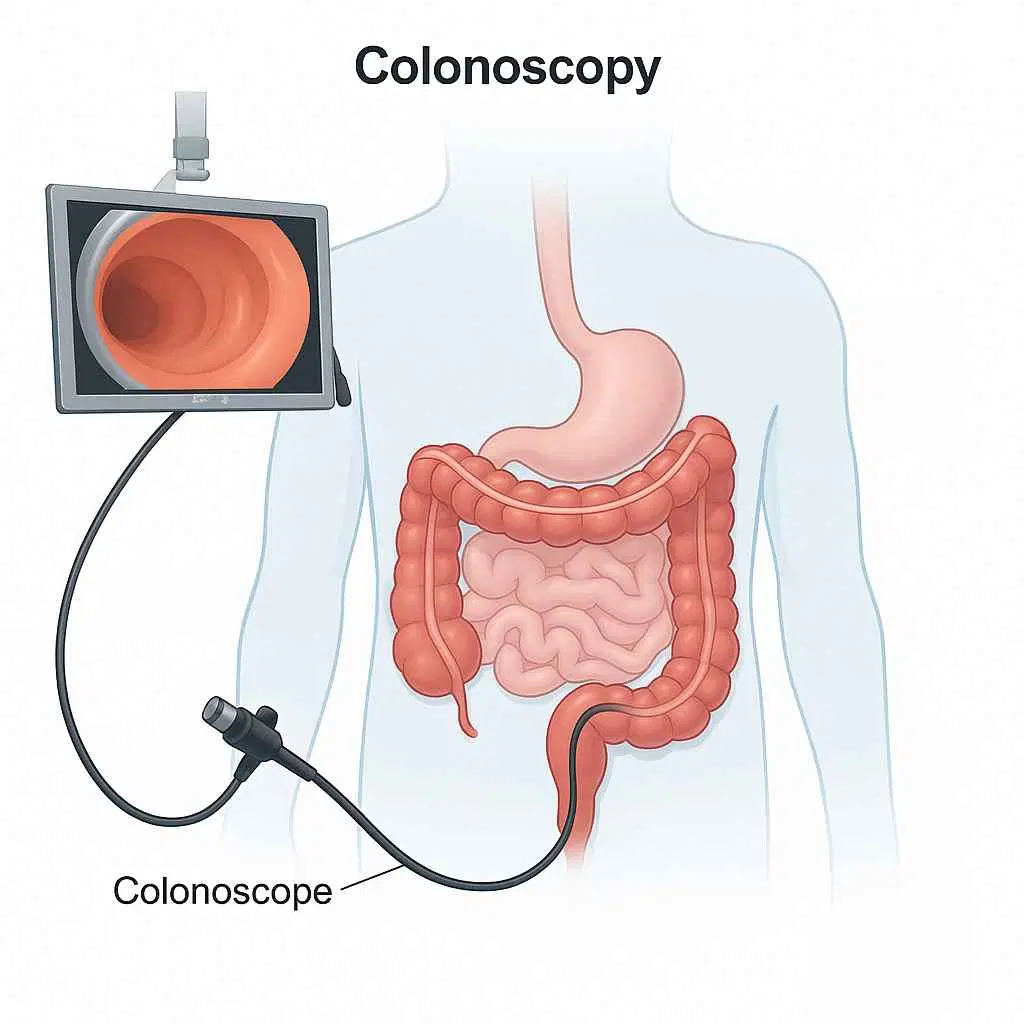
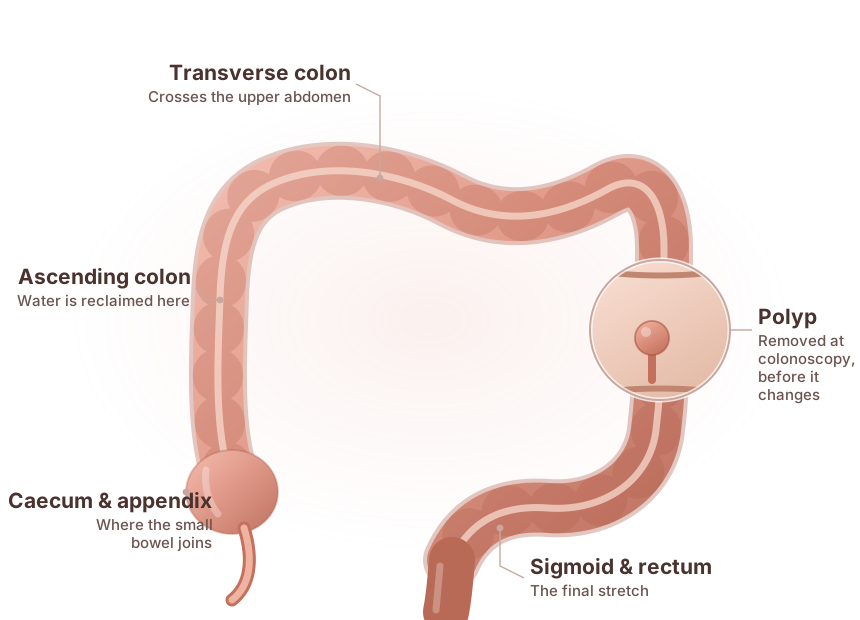
The large intestine is the final stretch of the digestive tract — roughly a metre and a half running from the caecum, up the right side, across the abdomen, down the left, and into the rectum. It reclaims water and salt from what the small intestine has finished with, and stores the residue until it leaves.
Most disease here is benign: polyps, diverticula, haemorrhoids, inflammation. Much of it can be diagnosed and treated during a single colonoscopy. What makes this organ unusual is its cancer — almost all colorectal cancer begins as an adenomatous polyp that takes years to turn malignant. That long window is why screening works better here than almost anywhere else in medicine: removing the polyp prevents the cancer outright rather than catching it early.
Advitya's colorectal programme brings gastrointestinal surgeons, gastroenterologists, radiologists, oncologists, stoma nurses and dietitians around a single table — so screening is timely, staging is precise, and sphincter preservation is considered in every case where the tumour allows it.
From a polyp snared at screening to a total mesorectal excision — each condition is managed by the same specialist team, using one shared treatment plan.
Growths on the bowel lining that accumulate genetic changes over years. Adenomatous polyps are the origin of the great majority of colorectal cancers — and removing them at colonoscopy interrupts that sequence entirely.
PreventableSmall pouches herniating through the colon wall, associated with low dietary fibre. Usually silent, but they can inflame, bleed or perforate — and recurrent complicated attacks are an indication for resection.
CommonUlcerative colitis and Crohn's disease — chronic immune-mediated inflammation managed medically first, with surgery held in reserve. Cancer risk rises with duration and extent, so surveillance matters.
Long-term careMalignancy of the caecum, ascending, transverse, descending or sigmoid colon. Often silent until it bleeds or obstructs, which is why iron-deficiency anaemia in an adult is investigated rather than simply treated.
Surgical oncologyStaged separately from colon cancer, because pelvic MRI and the mesorectal margin decide whether chemoradiation precedes surgery and whether the sphincter can be preserved.
MultidisciplinaryHaemorrhoids, fissures, fistulae and perianal abscess. Common, treatable, and worth examining properly — assuming piles without looking is the commonest route to a late cancer diagnosis.
Day careLynch syndrome and familial adenomatous polyposis carry very high lifetime risk. They need genetic counselling, family screening and intensive surveillance beginning in early adulthood rather than at 45.
GeneticIndividually these are common and often harmless. Together, or persisting beyond a couple of weeks, they deserve a colonoscopy rather than reassurance.
New constipation, looser stools or alternating between the two, lasting weeks.
Fresh blood, or darker blood mixed into the stool — never assume it is piles.
Iron deficiency in an adult implies slow blood loss from the gut until proven otherwise.
Colicky pain with distension, which can signal a partially obstructing lesion.
A persistent urge that passing stool does not relieve — typical of a rectal mass.
Weight loss alongside any of the above raises concern considerably.
Colonoscopy answers most questions directly — and treats what it finds in the same sitting. Everything else exists to stage what it discovers.
History, examination including digital rectal examination, and a review of every report.
Full blood count for anaemia, inflammatory markers, faecal immunochemical testing and CEA.
Direct visualisation of the whole colon, with polyp removal and biopsy in the same sitting.
Staging the extent of disease, with pelvic MRI mandatory for every rectal tumour.
Findings taken to a multidisciplinary board so the stage and plan are agreed once.
A written plan covering procedure, stoma discussion, recovery and surveillance schedule.
Endoscopic, laparoscopic and open approaches, alongside the medical and nutritional care that determines how well you recover.
Removal of polyps during colonoscopy, including endoscopic mucosal resection for larger flat lesions. No incision, no admission.
Keyhole removal of the affected segment for cancer, diverticular disease or polyps that cannot be snared, with faster recovery than open surgery.
The precision operation for rectal cancer — removing the rectum within its intact fascial envelope, preserving the sphincter wherever the tumour allows.
Removal of the entire colon for severe inflammatory bowel disease or familial polyposis, with pouch reconstruction where appropriate.
Adjuvant treatment after surgery for node-positive disease, and neoadjuvant chemoradiation before surgery for locally advanced rectal cancer.
Targeted anti-inflammatory and biologic therapy for ulcerative colitis and Crohn's disease, with structured monitoring for response and relapse.
Day-care treatment for haemorrhoids, fissures and fistulae, using stapled, laser and conventional techniques as the condition dictates.
Specialist stoma nursing before and after surgery, with dietetic support through the graded return to a normal diet.
Colorectal outcomes depend heavily on how often a team does this work — particularly for the rectum. Ours does it as its primary focus, close to where patients live.
Fellowship-trained gastrointestinal and colorectal surgical oncology, with mesorectal excision as core practice.
Surgeons, gastroenterologists, radiologists, oncologists, stoma nurses and dietitians working from one shared plan.
High-definition colonoscopy, CT staging and dedicated pelvic MRI protocols for rectal tumours.
Every rectal case is assessed for whether a permanent stoma can be avoided — and the reasoning is explained to you.
Scheduled surveillance colonoscopy, CEA monitoring and imaging once you are home — with the same faces throughout.
Six stages, from your first appointment to long-term surveillance — so you always know where you are and what comes next.
Your history and existing reports reviewed by a specialist, in person or by video.
Direct examination with polyp removal and biopsy, under sedation, as a day case.
CT and pelvic MRI, then a board decision on sequence, surgery and stoma if needed.
Endoscopic resection, laparoscopic surgery or chemoradiation — as planned.
Pain control, graded diet, early mobilisation and stoma training where relevant.
Surveillance colonoscopy, CEA monitoring and imaging on a defined schedule.
Detailed, plain-language guides written by our team — so the conversation in clinic starts from a better place.
What the large intestine does, the conditions that affect it, and how screening changes the outcome so decisively.
Read the guide BenignPolyps, diverticular disease, IBS and inflammatory bowel disease — symptoms, diagnosis and when surgery becomes necessary.
Read the guide OncologyRisk factors, the symptoms that matter, screening from 45, treatment options, recovery and prognosis by stage.
Read the guide SurgeryLocal excision, LAR, APR and total mesorectal excision — plus recovery, colostomy and life afterwards.
Read the guideAt 45 if you are at average risk. If a first-degree relative has had colorectal cancer, begin ten years before the age at which they were diagnosed. Symptoms at any age — bleeding, a persistent change in bowel habit, unexplained anaemia — mean colonoscopy now rather than at a screening milestone.
No. Haemorrhoids and anal fissures are far commoner causes than cancer. But the two cannot be distinguished reliably by symptoms alone, and assuming the benign explanation without examination is the single commonest reason colorectal cancer is diagnosed late. Bleeding warrants assessment, not reassurance over the phone.
It is performed under sedation and most patients remember little of it. The bowel preparation the day before is the part people find least pleasant, and modern low-volume preparations are considerably better tolerated than older regimens. The procedure itself usually takes twenty to thirty minutes.
In most colon operations, no — the bowel is rejoined during the same procedure. For rectal cancer a temporary stoma is sometimes created to protect the join while it heals, and is usually reversed after a few months. A permanent stoma is needed only when the tumour involves the anal sphincter itself, and we will tell you before surgery which situation applies to you.
Most episodes of uncomplicated diverticulitis settle with antibiotics and dietary modification. Surgery is reserved for:
A high-fibre diet after recovery reduces the chance of further episodes.
Expect three to seven days in hospital after major surgery, less after a laparoscopic procedure. Light activity resumes within a few weeks and full recovery typically takes four to six weeks. Diet returns gradually, starting low-fibre or soft, guided by our dietetic team.
To a considerable extent, yes — more so than most cancers. Regular colonoscopy detects and removes the polyps that would otherwise become cancer. Alongside that, a diet high in whole grains, fruit and vegetables, maintaining a healthy weight, regular exercise, and avoiding smoking and heavy alcohol each reduce risk independently.
Yes. For outstation patients, a video review of your existing scans, colonoscopy report and biopsy is usually the first step, so the trip is made only when it will change something. Bring the actual films or CD rather than only the printed report, along with previous prescriptions, discharge summaries and blood work from the last three months.
If you are over 45, or have symptoms at any age, a single day-case procedure is what stands between a polyp and a cancer.
+91 9211221551 · info@advityahealthcares.com · Reports reviewed before you travel