Change in Bowel Habit
New constipation, looser stools or alternating between the two, persisting beyond a few weeks and representing a genuine departure from your normal.

Screening colonoscopy, polyp removal and advanced colorectal surgery — because a polyp taken out today is a cancer that never happens.
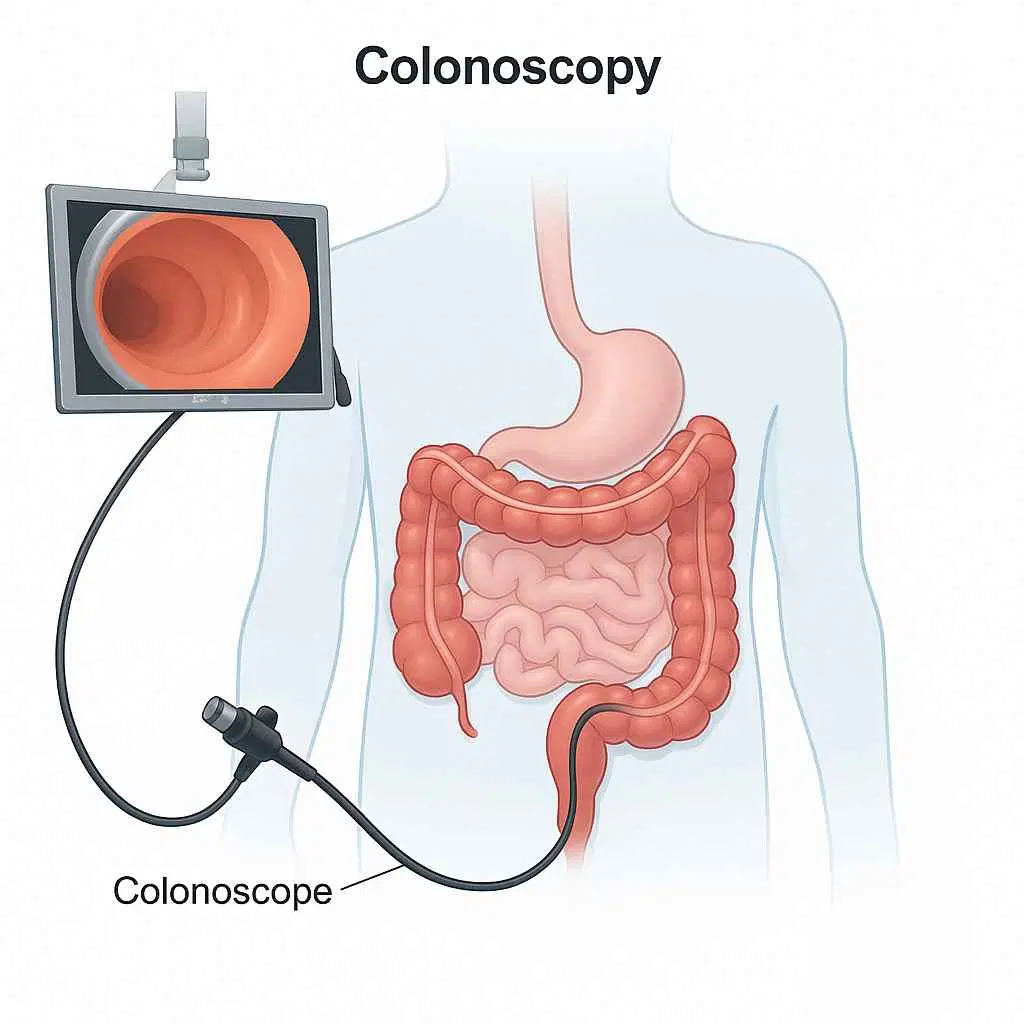

The colon and rectum form the final two metres of the digestive tract, where water is reclaimed and waste is stored before it leaves. Most disease here is benign — polyps, diverticula, haemorrhoids, inflammation — and much of it can be diagnosed and treated during a single colonoscopy.
Colorectal cancer is unusual among cancers in that it has a visible, removable precursor. Almost all of it begins as an adenomatous polyp, which takes years to become malignant. That long window is precisely why screening works so well here: taking out the polyp prevents the cancer entirely rather than catching it early.
The symptoms that matter are unglamorous and easy to normalise. A change in bowel habit lasting more than a few weeks, blood in the stool, or iron-deficiency anaemia in an adult are each sufficient reason for a colonoscopy. Attributing them to piles or diet without looking is the commonest route to a late diagnosis.
Discuss Your ReportsNone of these confirms a diagnosis on its own. Each is a reason to be examined rather than to wait and see how things develop.
New constipation, looser stools or alternating between the two, persisting beyond a few weeks and representing a genuine departure from your normal.
Fresh blood or darker blood mixed into the stool. Common causes are benign, but bleeding is never something to assume away without examination.
Colicky pain, often with bloating, which can indicate diverticular inflammation or a partially obstructing lesion.
Iron deficiency in an adult, particularly a man or a post-menopausal woman, implies slow blood loss from the gut until proven otherwise.
A persistent sensation of needing to pass stool that is not relieved, characteristic of a mass in the rectum.
Weight loss with any of the above raises concern considerably and should prompt investigation without delay.
Understanding what drives the condition is what makes prevention and early detection practical rather than theoretical.
Only the investigations that will change a decision are ordered, and they are sequenced so results build on one another rather than repeating.
Full blood count for iron-deficiency anaemia, inflammatory markers, and CEA where a cancer diagnosis is being followed.
Faecal immunochemical testing detects occult blood and is an effective first-line screening tool in average-risk populations.
The definitive investigation. It visualises the entire colon, removes polyps in the same sitting and takes biopsies where needed.
Staging for confirmed cancer, and the assessment of choice for acute complications such as perforation or obstruction.
Essential for rectal cancer. It defines the tumour's relationship to the mesorectal margin and determines whether treatment precedes surgery.
Treatment is matched to the stage and to the individual. Not every option below applies to every patient, and the right choice is made together.
Removal of polyps during colonoscopy, which interrupts the sequence to cancer before it can begin. No incision, no admission.
Targeted anti-inflammatory and biologic therapy for ulcerative colitis and Crohn's disease, with surgery held in reserve.
Keyhole removal of the affected segment for diverticular disease, large polyps or cancer, with faster recovery and less pain than open surgery.
The precision operation for rectal cancer, removing the rectum within its intact fascial envelope, with sphincter preservation wherever the tumour allows.
Specialist surgical care, delivered close to home, without asking families to relocate for months of treatment.
A dedicated hepato-pancreato-biliary and gastrointestinal surgical team, operating on these conditions as their principal practice rather than occasionally.
Endoscopy, endoscopic ultrasound, MRCP and protocol-specific cross-sectional imaging interpreted by clinicians who treat the disease themselves.
Fully equipped theatres, high-dependency support and endoscopy suites, delivered in partnership with hospitals close to where patients live.
Laparoscopic and endoscopic approaches wherever they are the right choice, with shorter stays, less pain and a faster return to ordinary life.
Reports reviewed before you travel, decisions explained in your own language, and a plan built around your circumstances rather than a protocol.
Acute pancreatitis, cholangitis and obstructive jaundice do not keep office hours. Our team is reachable when they present.

Dr. Kapoor leads Advitya's gastrointestinal and hepato-pancreato-biliary practice, with a focus on complex pancreatic, biliary and liver surgery. Her work centres on bringing specialist-level surgical care to regional hospitals, so that patients can receive the operation they need without leaving their families behind.
Pancreato-Biliary-Liver Surgery · Gastrointestinal Surgery · Surgical Oncology
Four steps, explained before they happen, so you always know what comes next.
We begin with your history and your existing reports. Bring every scan and biopsy — they shape the plan more than the symptoms do.
Only the investigations that will change a decision are ordered, sequenced so that you are not sent back and forth between departments.
Complex cases are discussed jointly by surgery, oncology and radiology, and the plan is explained to you and your family in full before anything begins.
Structured recovery with nutritional and physiotherapy support, and a defined follow-up schedule so nothing is left to chance.
Straight answers to the questions patients ask most often in clinic.
Current guidance recommends starting at forty-five for people at average risk. If you have a first-degree relative with colorectal cancer, screening should begin ten years before the age at which they were diagnosed. Symptoms at any age — bleeding, a persistent change in bowel habit, unexplained anaemia — mean colonoscopy now rather than at a screening milestone.
No. Haemorrhoids and anal fissures are far commoner causes than cancer. But the two cannot be distinguished reliably by symptoms alone, and assuming the benign explanation without examination is the single commonest reason colorectal cancer is diagnosed late. Bleeding warrants assessment, not reassurance over the phone.
It is performed under sedation and most patients remember little of it. The bowel preparation the day before is the part people find least pleasant. Modern preparations are lower in volume and better tolerated than older regimens, and the whole procedure typically takes twenty to thirty minutes.
In most colon operations, no — the bowel is rejoined during the same procedure. For rectal cancer, a temporary stoma is sometimes created to protect the join while it heals, and is usually reversed after a few months. A permanent stoma is needed only when the tumour involves the anal sphincter itself.
Most episodes of uncomplicated diverticulitis settle with antibiotics and dietary modification. Surgery is reserved for recurrent attacks that disrupt life, or for complications such as perforation, abscess, fistula or stricture. A high-fibre diet after recovery reduces the chance of further episodes.
Stage at diagnosis governs everything. Cancers confined to the bowel wall have five-year survival above ninety percent. This is precisely why screening matters so much — it shifts diagnosis from symptomatic, advanced disease to asymptomatic, early disease, or prevents it altogether by removing the polyp.
Connect with our experienced specialists for personalised diagnosis and treatment.
+91 9211221551 · info@advityahealthcares.com · Reports reviewed before you travel