Burning Upper Abdominal Pain
A gnawing or burning discomfort below the breastbone, classically relieved or provoked by eating depending on where the ulcer sits.

Accurate endoscopic diagnosis and treatment for gastritis, peptic ulcer disease and gastric disorders — because persistent indigestion deserves a look, not another prescription.
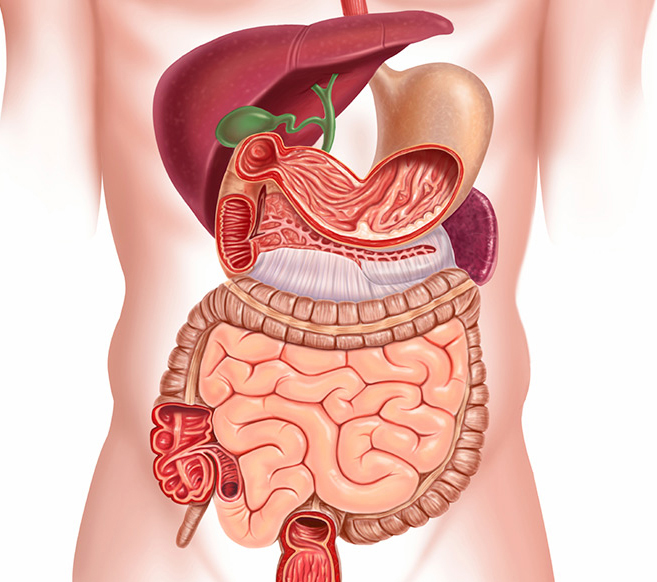

The stomach is a muscular reservoir that mixes food with acid and enzymes before releasing it into the small intestine. It protects itself from that acid with a mucus barrier, and almost all common stomach disease comes down to a failure of that barrier — through infection, medication or reflux.
Helicobacter pylori is the single most important cause. It colonises the stomach lining, provokes chronic inflammation, and is responsible for the great majority of peptic ulcers. It is also a recognised risk factor for gastric cancer. It is detectable by a simple breath, stool or biopsy test, and it is curable with a short course of combination therapy.
The clinical difficulty is that early gastric cancer produces exactly the same symptoms as ordinary indigestion. Nothing in the history reliably separates them. That is why persistent dyspepsia — particularly with weight loss, anaemia, vomiting or difficulty swallowing — should be investigated by endoscopy rather than treated empirically for months.
Discuss Your ReportsNone of these confirms a diagnosis on its own. Each is a reason to be examined rather than to wait and see how things develop.
A gnawing or burning discomfort below the breastbone, classically relieved or provoked by eating depending on where the ulcer sits.
Persistent sickness, particularly vomiting of food eaten hours earlier, which suggests delayed emptying or outlet obstruction.
Feeling full after only a few mouthfuls — an important symptom that patients rarely report unless specifically asked.
Digested blood from a bleeding ulcer. This is an emergency, not something to monitor at home.
Weight loss alongside dyspepsia substantially raises concern and is an indication for prompt endoscopy regardless of age.
Slow blood loss from an ulcer or tumour producing iron deficiency, often discovered on a routine blood test before anything else.
Understanding what drives the condition is what makes prevention and early detection practical rather than theoretical.
Only the investigations that will change a decision are ordered, and they are sequenced so results build on one another rather than repeating.
The definitive test. It visualises the lining directly, allows biopsy of anything abnormal, and can treat bleeding in the same sitting.
Urea breath test, stool antigen or biopsy urease testing, each accurate provided acid-suppressing medication has been stopped beforehand.
Full blood count for anaemia, and tumour markers such as CEA and CA 19-9 where malignancy is confirmed or suspected.
Staging for confirmed gastric cancer, assessing wall thickening, nodal involvement and distant spread.
Determines how deeply a tumour has invaded the gastric wall, which is what decides between endoscopic and surgical resection.
Treatment is matched to the stage and to the individual. Not every option below applies to every patient, and the right choice is made together.
A combination of two antibiotics with acid suppression for ten to fourteen days, followed by confirmatory testing to prove clearance.
Proton pump inhibitors to heal ulcers and control reflux, alongside review of any NSAID or aspirin that contributed.
Removal of early-stage lesions and large polyps through the endoscope, avoiding open surgery entirely where depth of invasion permits.
Subtotal or total removal of the stomach with a systematic nodal clearance for gastric cancer, followed by structured nutritional rehabilitation.
Specialist surgical care, delivered close to home, without asking families to relocate for months of treatment.
A dedicated hepato-pancreato-biliary and gastrointestinal surgical team, operating on these conditions as their principal practice rather than occasionally.
Endoscopy, endoscopic ultrasound, MRCP and protocol-specific cross-sectional imaging interpreted by clinicians who treat the disease themselves.
Fully equipped theatres, high-dependency support and endoscopy suites, delivered in partnership with hospitals close to where patients live.
Laparoscopic and endoscopic approaches wherever they are the right choice, with shorter stays, less pain and a faster return to ordinary life.
Reports reviewed before you travel, decisions explained in your own language, and a plan built around your circumstances rather than a protocol.
Acute pancreatitis, cholangitis and obstructive jaundice do not keep office hours. Our team is reachable when they present.

Dr. Kapoor leads Advitya's gastrointestinal and hepato-pancreato-biliary practice, with a focus on complex pancreatic, biliary and liver surgery. Her work centres on bringing specialist-level surgical care to regional hospitals, so that patients can receive the operation they need without leaving their families behind.
Pancreato-Biliary-Liver Surgery · Gastrointestinal Surgery · Surgical Oncology
Four steps, explained before they happen, so you always know what comes next.
We begin with your history and your existing reports. Bring every scan and biopsy — they shape the plan more than the symptoms do.
Only the investigations that will change a decision are ordered, sequenced so that you are not sent back and forth between departments.
Complex cases are discussed jointly by surgery, oncology and radiology, and the plan is explained to you and your family in full before anything begins.
Structured recovery with nutritional and physiotherapy support, and a defined follow-up schedule so nothing is left to chance.
Straight answers to the questions patients ask most often in clinic.
When it persists beyond a few weeks despite treatment, or when it is accompanied by any alarm feature — weight loss, difficulty swallowing, persistent vomiting, anaemia, or a palpable mass. New dyspepsia beginning after the age of forty-five also warrants endoscopy rather than empirical treatment.
A urea breath test, stool antigen test or biopsy taken at endoscopy will all detect it accurately. Acid-suppressing medication must be stopped for two weeks and antibiotics for four weeks beforehand, otherwise the test can be falsely negative.
Yes. Eradicating H. pylori and withdrawing the responsible medication cures the great majority of ulcers permanently. Confirming eradication afterwards matters, because ulcers recur in patients where treatment failed but was assumed to have worked.
It is curable when caught early. Tumours confined to the mucosa can sometimes be removed endoscopically with excellent outcomes. The difficulty is that early disease is symptomless or indistinguishable from indigestion, which is why endoscopy in the right patients is so important.
Eating changes permanently. The reduced reservoir means smaller, more frequent meals, and some patients experience dumping syndrome, where food passes into the intestine too rapidly. Vitamin B12 and iron need monitoring and often supplementation. With dietetic support, most patients adapt well within a few months.
Rarely. Almost all ulcers heal with medical treatment. Surgery is reserved for complications — perforation, uncontrolled bleeding that endoscopy cannot stop, or scarring that obstructs the gastric outlet.
Connect with our experienced specialists for personalised diagnosis and treatment.
+91 9211221551 · info@advityahealthcares.com · Reports reviewed before you travel